Balanced Parenting
From the February 2025 issue
The Value of You: Walking Humbly with Confidence
Exploring Self-Worth in Jewish Tradition
 By David Pelcovitz, Ph.D.

Any discussion of the Jewish approach to instilling a positive self-concept in children must first deal with an obvious question. How does one reconcile the strong emphasis that Jewish tradition puts on humility and modesty with the emphasis that psychology places on enhancing a child’s self-worth and importance? The following Talmudic passage is but one of many examples of the emphasis placed by our Sages on the importance of humility: Rava said, “It [the Torah] is not in the heavens” (Deuteronomy) 30:12) …neither will it be found in one who believes his mind is as broad as the ocean — it [the Torah] is not to be found with the person who, because of some level of Torah knowledge, is overly expansive in his self-esteem as the sea. R’ Yochanan said: “It is not in heaven” — it [the Torah] is not to be found among the arrogant (Eiruvin 55a).
In fact, the Talmud in Sukkah (29b) explains: The sin of arrogance is equivalent to all [the others]; in contrast, regarding the humble it says: “But the humble shall inherit the earth” (Psalms 37:11).
Rabbi Aharon Kotler, zt”l (of blessed memory), stresses the crucial importance of recognizing one’s self-worth. In Mishnas Rav Aharon (Volume One, p. 151), he explains that the essence of an individual’s identity is based on his ability to recognize his importance. We learn this, Rav Aharon explains, from the following Talmudic passage: Our Rabbis taught: He who eats in the marketplace is like a dog; and some say that he is unfit to testify (Kiddushin 40b). Expounding on this Talmudic passage, the Rambam says that we can’t accept the testimony of an individual who doesn’t respect himself. Rav Aharon asks, “Why nullify the testimony of somebody who eats publicly? What does self-respect have to do with honesty?” He explains that the greatest deterrent to falsehood lies in asking oneself, How can I do such a thing? Without respect for oneself, one is not able to have proper respect for others. Such an individual can’t be trusted to testify truthfully.
An episode that illustrates this point was told about a father who was concerned about the level of religious observance that his son would adhere to while attending graduate school away from his family and the intense Jewish environment in which he had been raised. He decided to bring his son to a rabbi for whom he had high regard to get a blessing before he left for the university. After giving the blessing the rabbi said that he would also like to give him advice on how to resist the temptations of living in a totally secular environment. Expecting advice that the university student should establish a relationship with a local rabbi who would be his teacher and mentor, the father and son were surprised when the rabbi suggested that he seek out a younger person to whom he would teach Torah. The rabbi explained that being a role model for somebody else would serve as an even greater motivator in keeping him loyal to Torah. If tempted to associate with the wrong friends and participate in unseemly activities, the graduate student would be restrained because he would be fearful that his student might see him and thereby lose respect for his teacher.
The Talmud in Sanhedrin (37a), marveling on the uniqueness of each individual, comments: If a man mints many coins from one mold, they all resemble one another, but the supreme King of kings, the Holy One, Blessed is He, minted every man in the stamp of the first man, and yet not one of them resembles his fellowman. Therefore every single person is obliged to say, “The world was created for my sake.”
The obvious question regarding this statement is how one reconciles this with the necessity to be humble as typified by Abraham who said, “I am but dust and ashes” (Genesis 18:27).
In a well-known statement regarding reconciling the seeming contradiction between these two apparently competing imperatives, Rav Simcha Bunim from Peshischa suggested that everybody needs to have two pockets that should be dipped into as needed: One pocket should contain the phrase, “The world was created for my sake,” and the other should have the words, “I am but dust and ashes.” The ideal balance in achieving an appropriate self-image is attained when individuals are able to reach into the appropriate pocket depending on the demands of the situation (Simchas Yisrael, Mamorei Simcha, Section 12).
Rabbi Shraga Feivel Mendlowitz, commenting on this insight of Rav Simcha Bunim, noted that people often reach into the wrong pocket at the wrong time. For example, when a person feels that he has been slighted by being given an honor in shul that he feels is beneath him, he reaches into the “The world was created for my sake” pocket and is inappropriately hurt and angry. When approached to do something for the community, however, he goes into the “I am but dust and ashes” pocket, claiming a false and misplaced sentiment that he isn’t up to the job.
In an age of indulgence and entitlement it is important for parents to note the context in which the Talmud discusses the concept of “The world was created for my sake.” The mishnah in Sanhedrin (37a) discusses this view of man in the context of a witness’s responsibility to testify reliably and honestly. In an attempt to instill a sense of awe about a witness’s responsibility in a capital case, the mishnah highlights the unique sanctity of each individual. The intention of teaching the concept of “The world was created for my sake” is, therefore, not to impart a sense of entitlement, but rather, to teach one’s responsibility to others.
Parental Role
Parents play a central role in the development of a child’s self-esteem. They play a pivotal part in the following factors that have been found to influence a child’s self-concept:
- A respectful, accepting attitude that children receive from others, particularly parents, is a key building block of a healthy sense of self. Repeatedly, studies have found that parents who provide a home that provides warmth, clear expectations, consistency and appropriate modeling are likely to raise children who experience high levels of self-esteem.
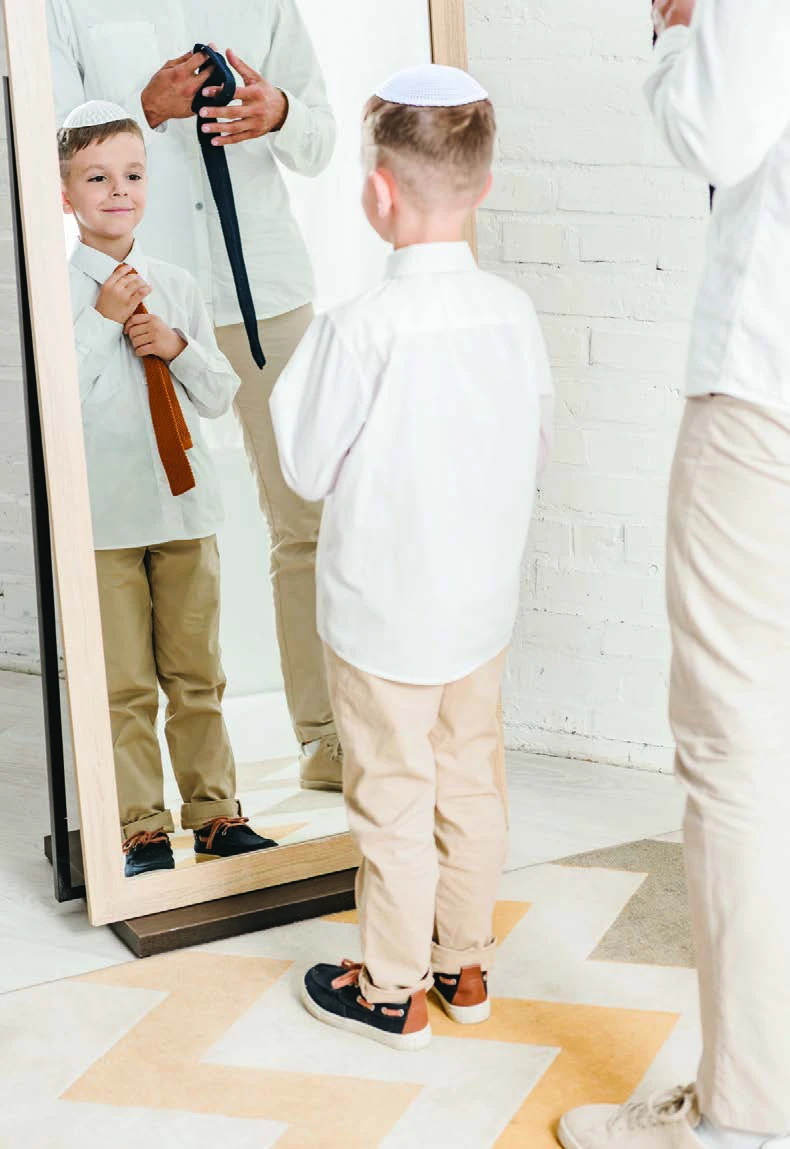
- The child’s history of success and the resulting status that this earns the youngster at school and at home is another key force shaping a child’s view of himself. A child’s self-esteem is largely the result of the mirrors held back to him by family members, teachers and peers. A high level of self-esteem is likely when the reflected appraisals of others are positive.
- How a child defines success or failure, as well as his general attitude toward negative feedback, is another important influence. This dynamic is shaped by both temperament and how the child is parented.
In addition to the forces that shape self-esteem, it is helpful to keep in mind that a child’s self-concept is not a monolithic concept. Psychologists describe the following dimensions that comprise self-esteem:
- Academic competence: How “smart” a child feels himself to be relative to his peers. Since intelligence is made up of multiple domains, it is possible to feel that one shines in one area of intelligence and is relatively weak in another. For example, a child who is a brilliant writer may feel “dumb” if he has difficulty with math. This domain of self-concept is particularly important for Jewish children, who typically live in an environment that emphasizes academic skills above most other assets.
- Physical Appearance: This is a particularly important source of self-esteem for girls. In a shidduch climate that often places inordinate emphasis on a girl’s weight and general appearance, physical self-concept can be a major contributor to a girl’s overall sense of worth. Research has shown that having a poor physical self-concept can be an important risk factor for eating disorders.
- Behavioral: How a child views his behavior relative to peers is another component of self-concept. If a child views himself as “bad” he may be more likely to engage in rebellious behavior and is at increased risk for gravitating toward negative peer influences.
- Athletic: In the Orthodox world, athletic ability is often not as major a force in shaping self-concept as in the general population. However, parents of young boys know that a child who is a poor athlete often feels badly about himself, particularly during his elementary school years.
- Social: Feeling popular, particularly during adolescence — when fitting in with one’s peer group is a major psychological need — is another major dimension of self-esteem.
Of course the sum can be greater than each of its parts. A child’s global self-worth may be excellent, even if he suffers from a poor self-image in some of the above dimensions. The combination of a child’s temperament, how his parents make him feel about himself and how much relative importance he assigns to a particular component of self-esteem will determine each child’s overall self-image.
This approach to understanding self-esteem has several practical implications. Research has found that helping youngsters discount the importance of domains in which they are not competent or facilitating an improvement in their competence in areas where they are weak are among the more effective ways of improving children’s self-images. For example, in the case of children who are not particularly skilled athletes, self-esteem can improve by helping them see how, in the long run, this says nothing about their value as a person — while other areas of competence, such as academic skill or good character traits, are far more valuable assets. Another effective approach would be to give such an individual coaching that would improve his athletic skills. Of course, an approach using both of these strategies would have the best chance of improving the child’s self-esteem.
Development of Self-concept
Children’s self-concepts become increasingly stable as they grow older. Until the typical child starts school he tends to view himself in an unrealistically positive and optimistic light. His true abilities have not been tested by day-to-day comparison to peers. Consequently, preschoolers will often describe themselves as being the “smartest” or “strongest,” regardless of their true behavior and skills. Research finds that as children move through the early elementary school years their sense of competence sees a decline relative to the preschool years. Their sense of self becomes increasingly more objective and grounded as they forge a sense of relative confidence by comparing their abilities to those of their classmates. In the laboratory of real life, young children gradually discover that they have strengths in some areas and weaknesses in others.
Self-concept gradually improves and stabilizes as children go through the later elementary school years. Parents should be aware, however, that there are various transition points where a child’s sense of worth typically declines. This is especially true during the early adolescent years — a period often marked by insecurity and a lack of confidence. As the young teen undergoes the transition from elementary school to middle school and endures the stresses that often attend the onset of puberty, many domains of self-concept have been found to drop. A sense of confidence and competence typically reemerges during the latter years of high school. The above is only a very general map of how self-concept develops in a typical child. Any child who feels inferior to peers in academic ability, popularity, athletic skills, appearance or behavior will have low self-esteem in that area regardless of his or her stage of development. Despite competence, children who are raised in a home that is dominated by criticism, a punitive disciplinary style, or a failure to find a balance between love and limits will also be at risk for suffering the ill effects of a poor self-concept.
Subtle Contributions to Self-Esteem

One of the most powerful contributors to self-esteem is a child’s perception of what he is capable of doing. This is shaped both by the expectations of others, as well as the expectations he has of himself. In Chovas HaTalmidim, the Piacesner Rebbe asked his students to try to picture where they wanted to be in six months. He recognized that a child’s dreams and aspirations are powerful forces that shape his ability to actualize his potential.
In one of the classic experiments in the field of psychology,⁷ a group of researchers randomly chose one out of five elementary school children in 18 classrooms. Their teachers were told that these students were unusually bright and were expected to make remarkable progress during the coming academic year. Even though these children had no greater inherent potential than the other 80 percent of their classmates, they made unusual progress during the year that their teachers viewed them as gifted. Relative to their peers, significant increases in verbal skill, reasoning ability and overall intellectual ability were documented on intelligence and achievement tests that they were given at the end of the year.
The authors of this study speculate that expectations of children are transmitted in the most subtle of ways. Facial expressions, posture and tone of voice are all unconscious, yet powerful ways that communicate expectations. This is certainly the case with children. Parents often shape a child’s view of what he can and can’t do via the subtle expression of a raised eyebrow or an understated scowl. Setting appropriately high standards for one’s children while, at the same time, not overwhelming them with inappropriately high expectations is an important ingredient in raising children with high levels of self-esteem
Ultimately, raising children with strong self-esteem isn’t about perfection— it’s about intention. When parents model humility, demonstrate respect, and show that effort matters more than immediate results, they lay the foundation for their children to grow into confident, grounded individuals. As with all aspects of parenting, a little patience, empathy, and self-awareness can make a world of difference in shaping the next generation.
About the contributors
Dr. David Pelcovitz
Dr. David Pelcovitz, a renowned clinical psychologist with over 45 years of experience, has dedicated his career to helping individuals and families navigate trauma, child abuse, and parenting challenges. He is widely respected for his compassionate approach and deep insights, which have made a significant impact in both clinical and academic settings. Dr. Pelcovitz holds the prestigious Straus Chair in Psychology and Education at Yeshiva University's Azrieli Graduate School, where he mentors future leaders in Pastoral Psychology and advises the university as Special Assistant to the President. Previously, he held prominent roles at North Shore University Hospital and NYU School of Medicine, shaping the fields of psychology and psychiatry. A gifted author and speaker, Dr. Pelcovitz has written extensively on topics of resilience and faith, including Life in the Balance: Torah Perspectives on Positive Psychology and Balanced Parenting, co-authored with his late father, Rabbi Raphael Pelcovitz zt”l. His work is widely celebrated for blending psychological expertise with timeless Jewish wisdom.
More by and about Dr. David Pelcovitz