HERITAGE · FAMILY HISTORY
A Hidden Treasure
The Menashe Gross family, in its own handwriting.
Births recorded in the margins of a sefer. A rabbi’s recommendations. A stamped book and an American citizenship certificate. A family’s past comes into focus, one document at a time.
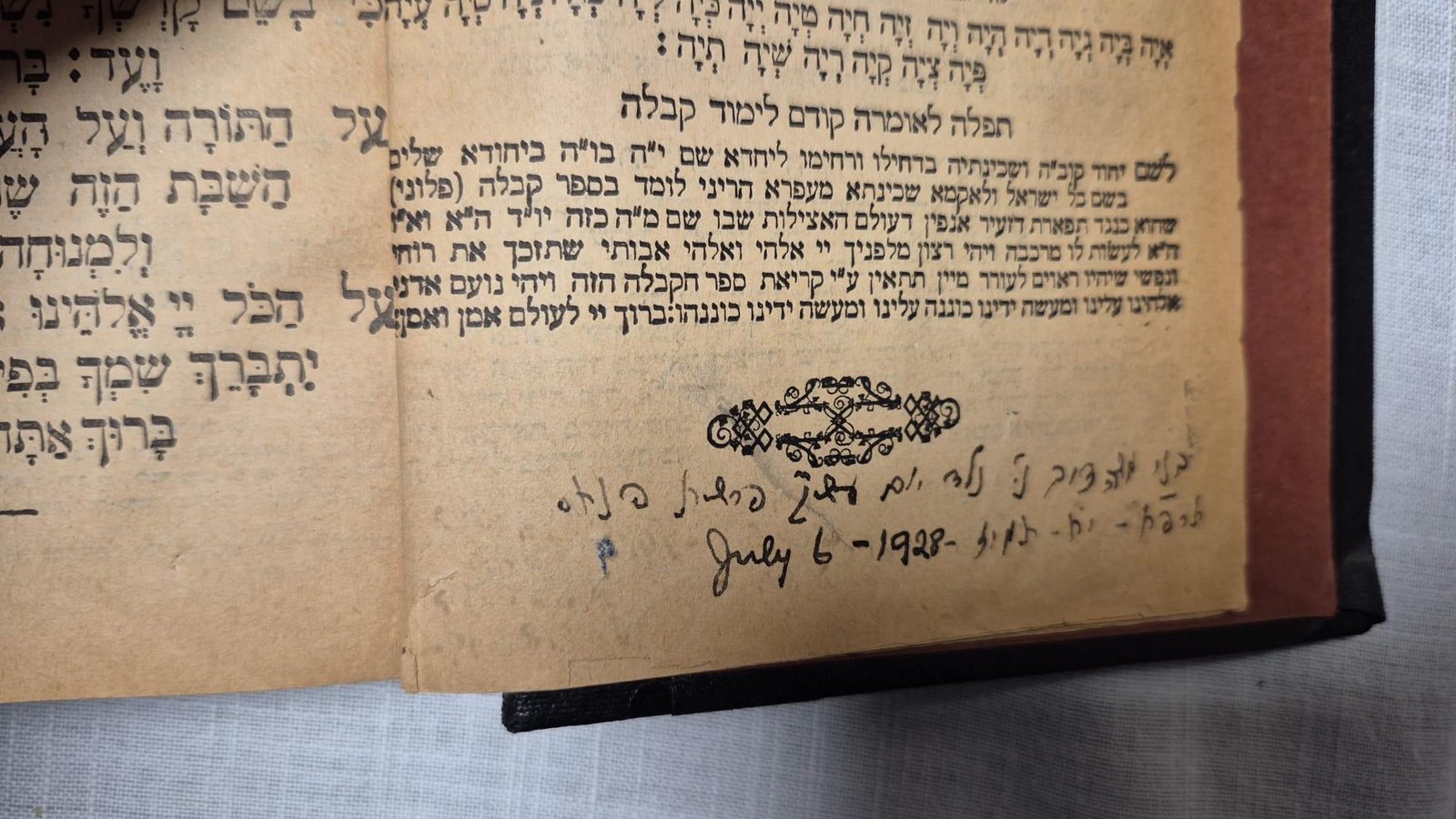
In the lower margins of an old sefer, beneath printed prayers and lines of religious instruction, a father recorded the arrivals that shaped his family. A daughter. A son. A weekday, a Hebrew date, a place in the annual cycle of Torah readings. Sometimes, a civil date as well.
Now those handwritten lines are being read together again. A family research effort involving Sender Gross, his uncle Shragi Gross, Dr. Shnayer Leiman and Ellie Gross has brought renewed attention to a birth register the family attributes to Menashe Gross, Sender’s great-grandfather and the father of Rabbi Alexander S. Gross.
The photographs preserve eight birth entries spanning 1910 to 1928. Now three additional sources broaden the picture: rabbinic testimonials, the stamped title page of an old sefer, and a United States naturalization certificate dated June 30, 1927. Together they let us examine a family through the records it preserved.
One family, several branches
A published account of Miriam Mendlowitz’s life identifies her as the eldest child of Menashe and Chana Gross and gives her birthday as January 14, 1910—4 Shevat. That date agrees with the first entry in the photographed register. Miriam later married Reuvain Mendlowitz, providing a documented connection between the Gross and Mendlowitz families. The same account identifies her younger sister as Hench Leiman.[1]
Dr. Shnayer Leiman’s published biography names his parents as Rabbi Harold I. Leiman and Harriet, née Gross.[5] Read alongside the account of Miriam and her sister, it helps place the Leiman branch within the family story. The register itself uses a Hebrew-script personal name; it does not supply an English surname or a family tree.
Leiman’s involvement also brings the perspective of a scholar devoted to Jewish history. Touro University has identified him as a distinguished professor in its Graduate School of Jewish Studies. His private Leiman Library preserves books, photographs, pamphlets and other material relating to Jewish life.[3][4]
Reading a father’s record
The entries repeatedly begin with בתי, “my daughter,” or בני, “my son.” Their language is primarily Hebrew, with Yiddish forms of names and civil months, and occasional English date notations. The blessings attached to the names are part of the record’s intimate character.
Several entries offer more than one way to locate a birth in time. Yechiel’s entry, for example, places it on a Monday, Rosh Chodesh Shevat, in the week of Bo, and adds January 30, 1911. These details agree. The entry read as Yehuda Chaim gives Thursday, 20 Adar I 5673, and February 27, 1913; those calendar details agree as well, although the personal-name reading remains tentative.
A calendar check can test whether details fit together. It cannot recover a blurred letter or establish who wrote a line. The translations below therefore distinguish readable dates from uncertain spellings and overwritten passages.
A home remembered beyond the family
The Gross name also appears in a firsthand recollection published decades before this rediscovery. In “Song of Faith,” in the January 1978 issue of The Jewish Observer, Rabbi Lewis Brenner recalled visiting the home of Mr. and Mrs. Menashe Gross on Rodney Street with his grandmother. He remembered Rav Shraga Feivel Mendlowitz teaching in the Gross sukkah and described the home’s place in the religious life of its community.[2]
That account supplies a meaningful historical parallel to the domestic record in these photographs. One source remembers a home that welcomed Torah teaching. The other preserves the births within a family whose descendants carried their own stories forward. The photographs do not, by themselves, establish every relationship to the wider Mendlowitz family, and those connections should not be inferred from a shared surname.
A date that deserves a careful second look
The entry the family associates with Rabbi Alexander S. Gross is especially important. Although its name and civil date include overwritten marks, its calendar details point to Wednesday, 8 Elul 5676, in the week of Ki Seitzei: September 6, 1916. A commonly available public biography gives his birth year as 1917.[6]
The newly supplied naturalization certificate adds a useful comparison: it lists a child named Seymour, age ten, in June 1927. If Seymour is the child in the September 6 entry, that age is consistent with a 1916 birth. The correspondence between the names remains a working identification, so the conflicting 1917 biography is retained here rather than silently corrected.
Which sefer held the record?
The visible printed headings identify prayers to be said before studying the Prophets, the Writings, Mishnah and Kabbalah. The text above the earliest entries matches passages from Orchos Chaim, the ethical instructions attributed to Rabbeinu Asher. The study prayers also appear in Chok L’Yisrael.[7][8]
Those matches identify the printed passages, but do not uniquely identify the volume. A newly supplied title page, reproduced below, identifies an 1858 edition of Kol Yaakov bearing a Menashe Gross ownership stamp. It has not yet been established that the birth-register leaves and that title page came from the same physical book; identifying one family-owned volume does not, by itself, identify the other leaves.
What the margins give back
The value of this discovery does not depend on making every line more certain than it is. It gives descendants a record they can examine together: names in an older hand, dates that can be checked, and questions that can now be asked more precisely.
A family’s past rarely arrives as a complete narrative. Here, it arrives in a few lines beneath a prayer—enough to reconnect a name with a birthday, a child with a parent, and a present generation with the lives that preceded it.
Three additional sources
A family’s story, in different kinds of records
A personal register, a rabbi’s testimonial, a book-owner’s stamp and a government certificate answer different questions. Each is presented below with the source image and a reading that distinguishes clear text from uncertain handwriting.
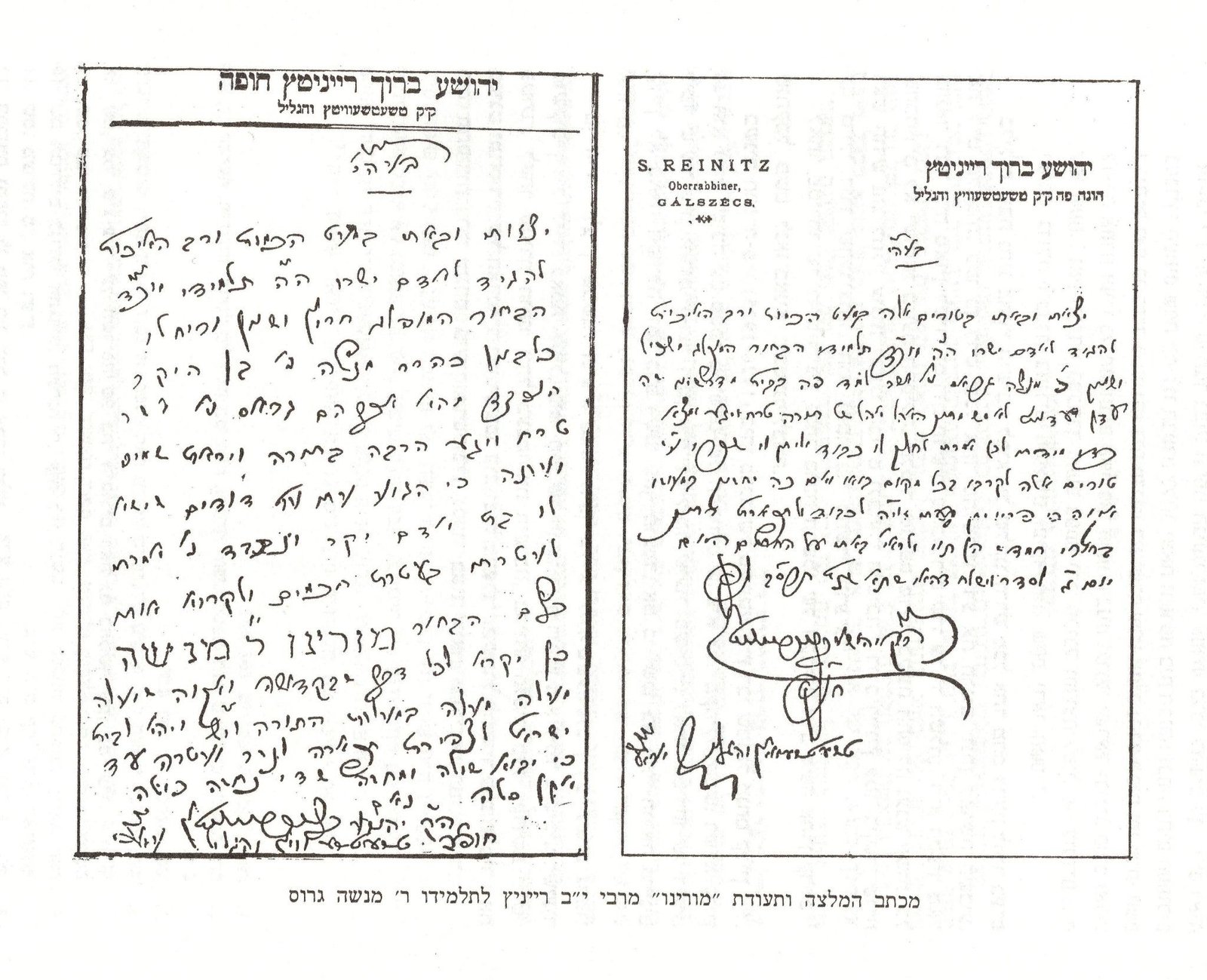
Rabbi Yehoshua Baruch Reinitz’s letters
Torah learning, character, and the title Morenu.
What the printed text says
The letterhead names יהושע ברוך רייניטץ, Yehoshua Baruch Reinitz. The Latin-letter heading reads “S. Reinitz, Oberrabbiner, Gálszécs”: “S. Reinitz, Chief Rabbi, Gálszécs.” The accompanying Hebrew caption reads:
מכתב המלצה ותעודת ״מורינו״ מרבי י״ב רייניץ לתלמידו ר׳ מנשה גרוסTranslation: “A letter of recommendation and a ‘Morenu’ certificate from Rabbi Y. B. Reinitz to his student, R. Menashe Gross.”
The handwritten recommendations
The left-hand document describes the recipient as the writer’s student and praises him as an outstanding young man, incisive and keen in learning. Readable phrases commend Torah learning and fear of Heaven; the name Menashe and the honorific Morenu appear in the text. The right-hand page is a companion testimonial on the same rabbi’s stationery.
Selected legible expressions
- תלמידי
- “My student.”
- הבחור המופלג חריף ושנון
- “The outstanding young man, incisive and keen [in learning].”
- בתורה ויראת שמים
- “In Torah and fear of Heaven.”
- מורינו
- “Our teacher,” an honorific used in the certificate.
These are translated excerpts and a reading of the documents’ evident purpose, not a complete line-by-line transcription. Several words and the signatures need specialist handwriting review. The caption calls one document a Morenu certificate; the precise scope of any rabbinic authorization should not be inferred from that title alone. No issue date is confidently established here.
קול יעקב — Kol Yaakov, 1858
An identifiable title page, with a familiar name stamped onto it.
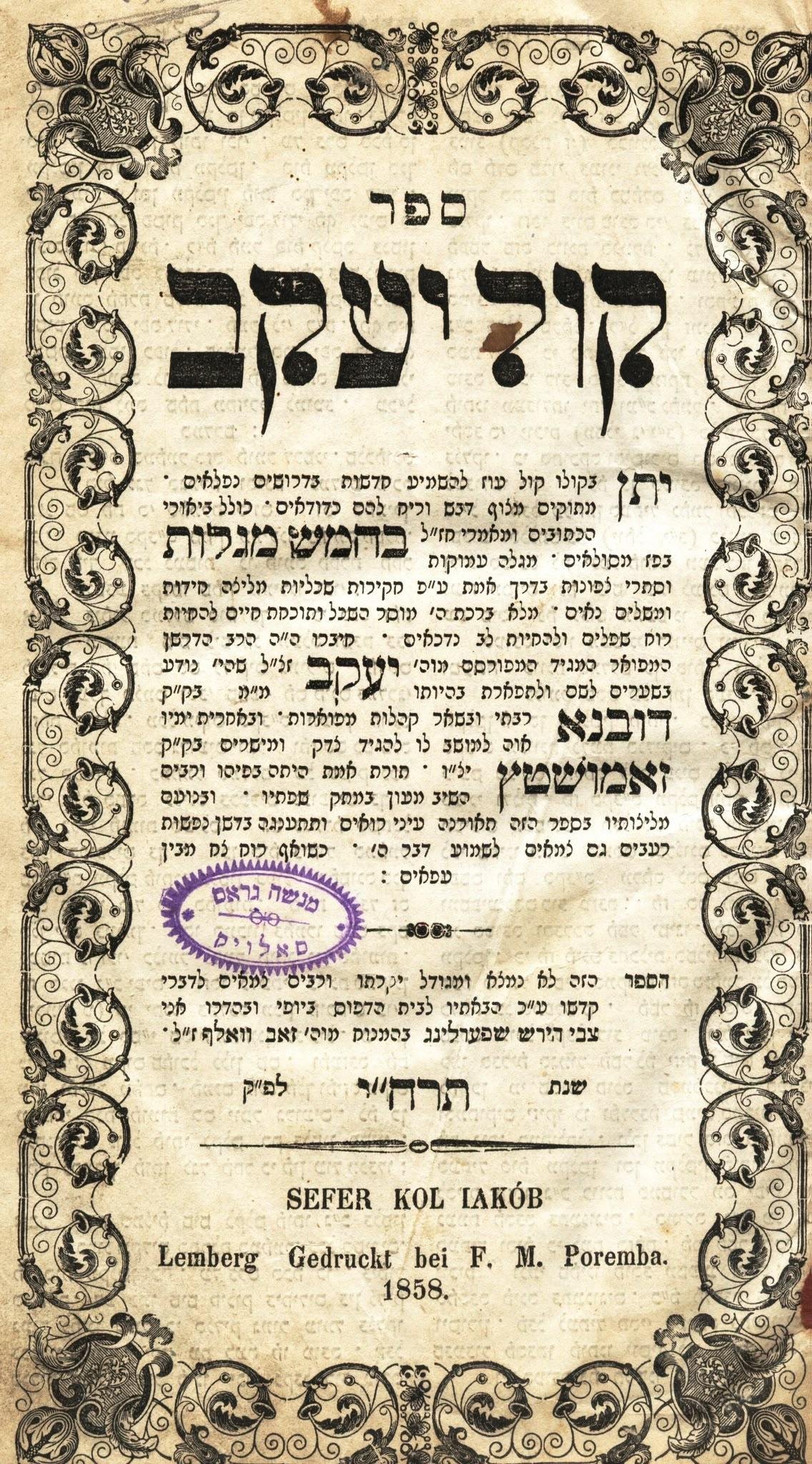
Title-page translation
Sefer Kol Yaakov means “The Book, the Voice of Jacob.” The page describes interpretations of biblical passages and teachings of the Sages on the Five Megillos, with explanations and parables, by Rabbi Yaakov, the preacher of Dubno, commonly known as the Dubner Maggid.
The German imprint at the foot of the page is particularly clear:
“Sefer Kol Iakób. Lemberg. Gedruckt bei F. M. Poremba. 1858.”
Translation: “The Book Kol Yaakov. Lemberg. Printed by F. M. Poremba. 1858.” The Hebrew year printed above it is תרי״ח, 5618.
The ownership stamp
The purple oval stamp reads מנשה גראס — Menashe Gross. The smaller locality line beneath the name is not confidently resolved from this photograph.
This establishes the title and imprint of the photographed book and records the name stamped on this copy. It does not establish when Menashe acquired it, nor that the earlier birth-register leaves came from this same volume. The English above renders the bibliographic information and substance of the title page, rather than every ornamental phrase.
Naturalized in Scranton, June 30, 1927
The name on the certificate is “Menhert Gross.” The family supplied it as Menashe Gross’s naturalization record.
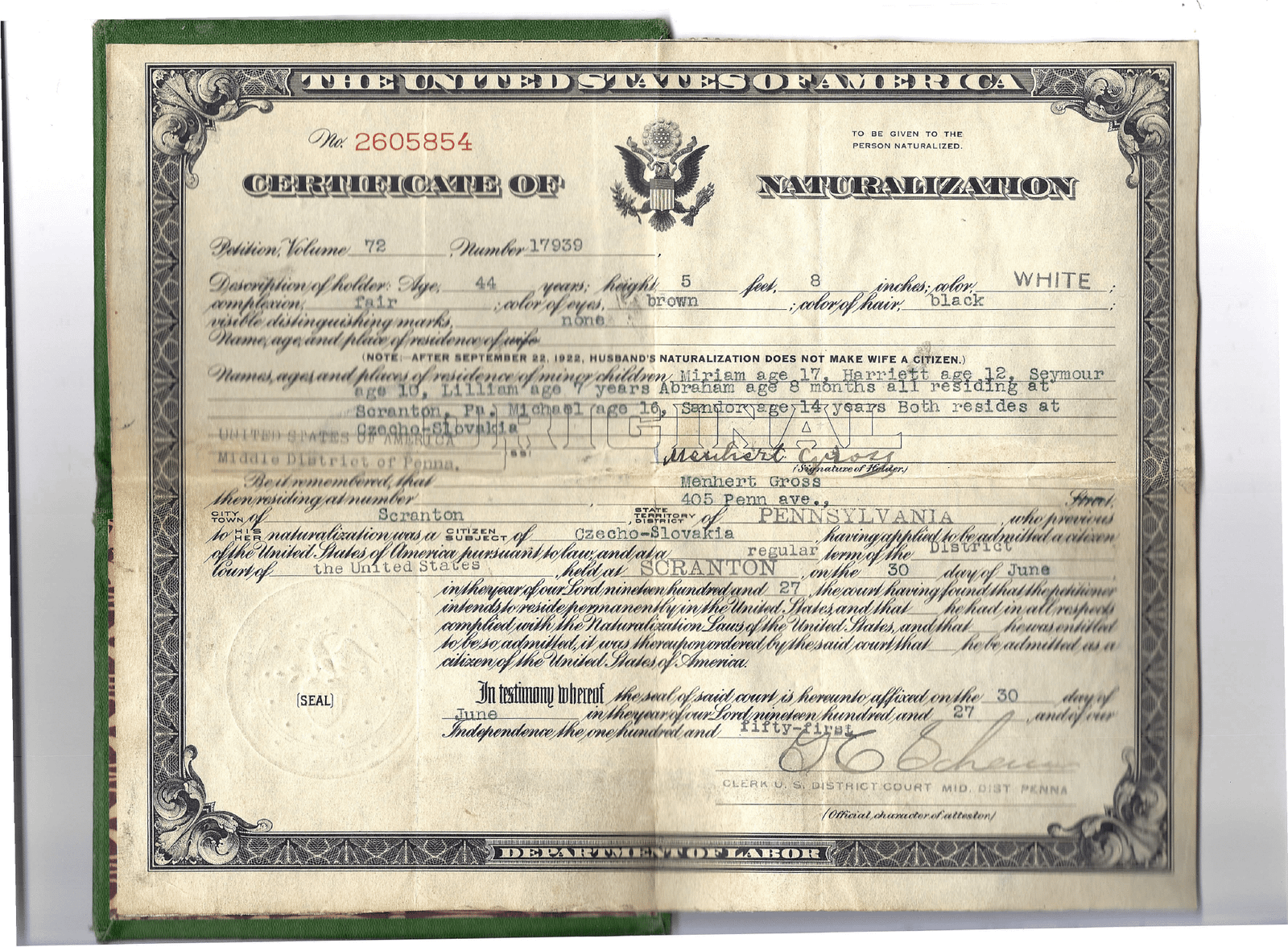
The certificate in plain English
The certificate records that Menhert Gross, living at 405 Penn Avenue, Scranton, Pennsylvania, was admitted as a United States citizen on June 30, 1927 by the federal district court at Scranton. His former citizenship is entered as Czecho-Slovakia. It describes him as age 44, five feet eight inches tall, with a fair complexion, brown eyes, black hair and no visible distinguishing marks. The form’s historical “color” field reads “WHITE.”
The document is certificate No. 2605854, with petition volume 72 and petition number 17039. The line for the wife’s name, age and residence is blank in this copy. This is a citizenship record, not an arrival manifest, and its date should not be presented as his immigration date.
Seven children named on the certificate
| Name as typed | Age as entered | Residence as entered |
|---|---|---|
| Miriam | 17 | Scranton, Pennsylvania |
| Harriett | 12 | Scranton, Pennsylvania |
| Seymour | 10 | Scranton, Pennsylvania |
| Lillium [spelling uncertain] | 7 | Scranton, Pennsylvania |
| Abraham | 8 months | Scranton, Pennsylvania |
| Michael | 16 | Czecho-Slovakia |
| Sandor | 14 | Czecho-Slovakia |
The table retains the certificate’s civil names and entered ages. It does not silently substitute Hebrew names from the birth register. “Lillium” is a tentative reading of the typed name; a clearer original could resolve its spelling.
What the two records add to each other
Miriam’s age of seventeen agrees with the register’s January 1910 birth; Harriett’s age of twelve is compatible with the October 1914 entry; and the younger children’s ages offer further points for comparison. The certificate also preserves a family divided between Scranton and Czecho-Slovakia. A published account of Miriam’s life similarly describes two older brothers staying behind initially for yeshiva study.[1]
The register’s last entry, July 1928, falls after this certificate was issued. Seven names in the June 1927 certificate and eight births in the later register therefore need not be a contradiction. Matching every civil name to a Hebrew entry, however, requires more evidence than age alone.
The family register
Eight entries, in chronological order
Working readings from the supplied photographs. Brackets mark uncertain or reconstructed text. Dates are checked against the Hebrew calendar; personal identifications are not established by calendar agreement.
| Name as read | Civil date | Hebrew date | Day / Torah portion |
|---|---|---|---|
| Miriamמרים | 4 Shevat 5670 | Friday · Bo | |
| Yechielיחיאל | 1 Shevat 5671 | Monday · Bo | |
| Yehuda Chaimיהודא חיים | 20 Adar I 5673 | Thursday · Vayakhel | |
| Hentshe / Hench[הנטשא / הנטשע] | 19 Tishrei 5675 | Friday · Chol Hamoed Sukkos | |
| Sender / Alexander[סענדר] | 8 Elul 5676 | Wednesday · Ki Seitzei | |
| Leahלאה | 11 Elul 5679 | Shabbos · Ki Seitzei | |
| Avrahamאברהם | 12 Kislev 5687 | Thursday · Vayishlach | |
| Mordechaiמרדכי | 18 Tammuz 5688 | Friday · Pinchas |
Miriam
January 14, 1910 · 4 Shevat 5670
בתי מרים נולדה יום ו׳ לסדר בא — ד׳ שבט [תר״ע] לפ״ק; [יאנואר] 1910.
My daughter Miriam was born on Friday, in the week of Bo, 4 Shevat.
The Hebrew day supplies January 14; the civil line gives January 1910. A published biography independently confirms the full date.
Yechiel
January 30, 1911 · 1 Shevat 5671
בני יחיאל נ״י נולד ר״ח שבט יום ב׳ לסדר בא תרע״א; יאנואר 30 1911.
My son Yechiel was born on Rosh Chodesh Shevat, Monday, in the week of Bo, 5671. January 30, 1911.
Name is a working reading; date, weekday and Rosh Chodesh agree.
Yehuda Chaim
February 27, 1913 · 20 Adar I 5673
בני [יהודא חיים] נ״י נולד יום ה׳ לסדר ויקהל תרע״ג; פברואר 27 1913; כ׳ אדר ראשון.
My son [Yehuda Chaim] was born on Thursday, in the week of Vayakhel, 5673; 20 Adar I. February 27, 1913.
Personal-name reading remains tentative. The calendar information agrees.
Hentshe / Hench
October 9, 1914 · 19 Tishrei 5675
בתי [הנטשא / הנטשע] תחי׳ נולדה יום ב׳ דחוה״מ סכות תרע״ה; יום עש״ק [בבוקר]; אקטאבער 9 1914.
My daughter [Hentshe], may she live, was born on the second day of Chol Hamoed Sukkos, 5675, Friday morning. October 9, 1914.
The handwritten name has an uncertain letter/spelling. “Second day” agrees with the diaspora observance of Chol Hamoed. The identification with Hench (Harriet) Leiman is supported by family context, not an English name on the page.
Sender / Alexander
September 6, 1916 · 8 Elul 5676
בני [סענדר] נ״י נולד יום ד׳ פרשת תצא ח׳ אלול תרע״ו; Sep. 6 [1916].
My son [Sender] was born on Wednesday, in the week of Ki Seitzei, 8 Elul 5676. September 6, 1916.
The name and civil line are partly overwritten. The Hebrew year, weekday and Torah portion support 1916. Identification with Rabbi Alexander S. Gross is the family’s; a commonly available public biography lists 1917.
Leah
September 6, 1919 · 11 Elul 5679
בתי לאה תחי׳ נולדה יום שבת י״א אלול תרע״ט לפ״ק; Sep. 6 [1919].
My daughter Leah, may she live, was born on the holy Shabbos, 11 Elul 5679. September 6, [1919].
The civil year has been heavily overwritten. Reading 1919 is supported by the Hebrew year and Shabbos/11 Elul combination.
Avraham
November 18, 1926 · 12 Kislev 5687
בני אברהם נ״י נולד יום ה׳ לסדר [וישלח] י״ב כסלו תרפ״ז; Nov. 18 [1926].
My son Avraham was born on Thursday, in the week of Vayishlach, 12 Kislev 5687. November 18, 1926.
The final civil-year digit is near the gutter; the Hebrew date and weekday agree with 1926.
Mordechai
July 6, 1928 · 18 Tammuz 5688
בני מרדכי נ״י נולד יום עש״ק פרשת פנחס לפ״ק — ח״י תמוז תרפ״ח; July 6 1928.
My son Mordechai was born on the eve of the holy Shabbos [Friday], in the week of Pinchas; 18 Tammuz 5688. July 6, 1928.
The name is faint but reads as Mordechai; the date and weekly portion agree.
How to read the abbreviations
נ״י is commonly nero ya’ir, “may his light shine”; תחי׳ means “may she live”; לפ״ק means “according to the minor reckoning,” omitting the thousands in a Hebrew year. עש״ק means Friday, the eve of the holy Shabbos. לסדר refers here to the week of a Torah portion. These conventional blessings are omitted from some of the concise English date translations above.
Hebrew dates begin at sunset. The calendar checks compare the written dates as daytime dates; they do not establish a birth time where none is readable. The photographs do not establish when the entries were written or whether they were all entered at the time of birth.
The source photographs
The pages, in reading order
The earliest five entries are on the right-hand page of the open spread. Continue onto the left-hand page for Leah and Avraham, then turn to the page with the Kabbalah prayer for Mordechai. Two of the four submitted photographs show the same Mishnah page. Images below are rotated for reading; their writing has not been retouched.
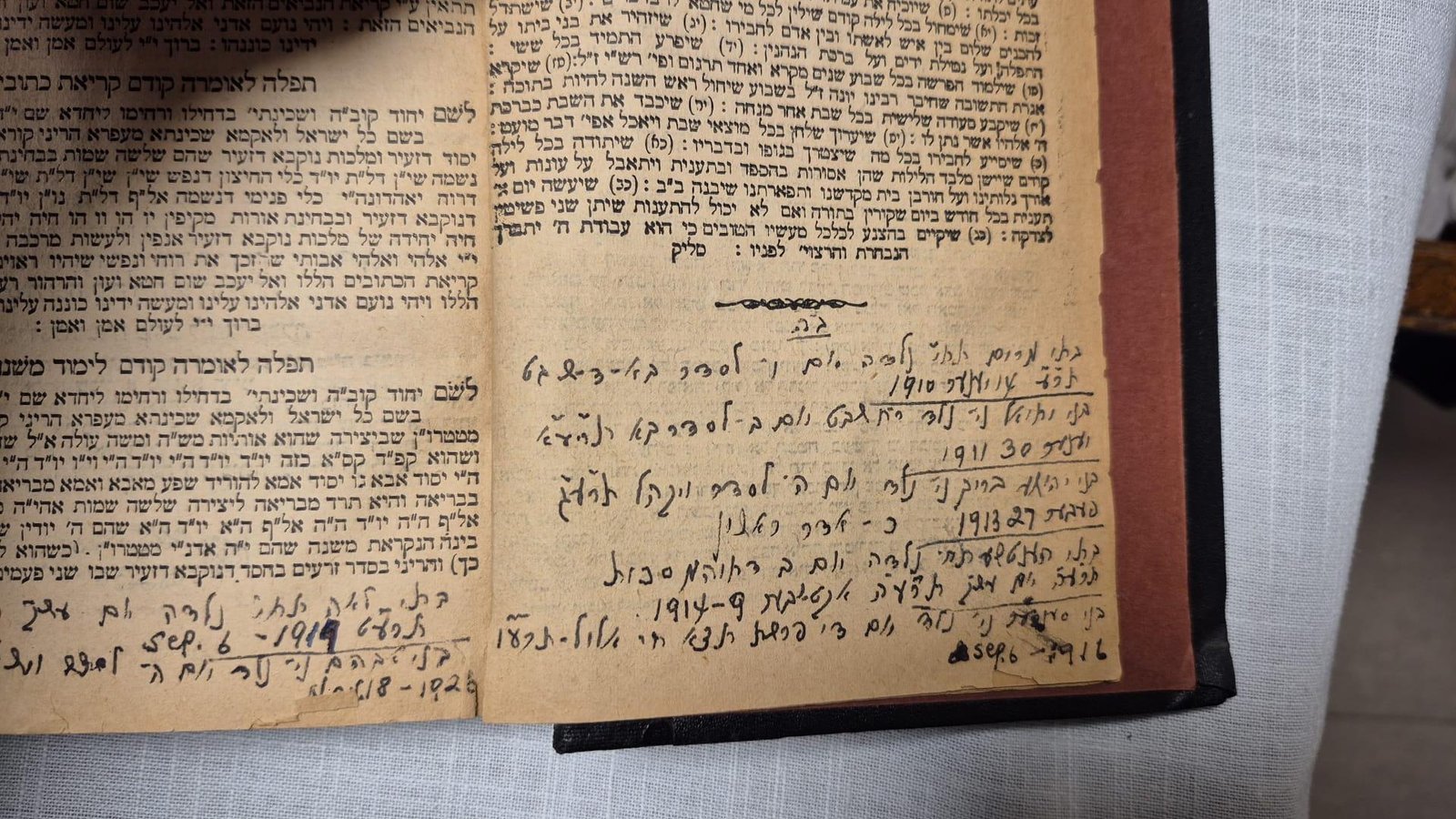
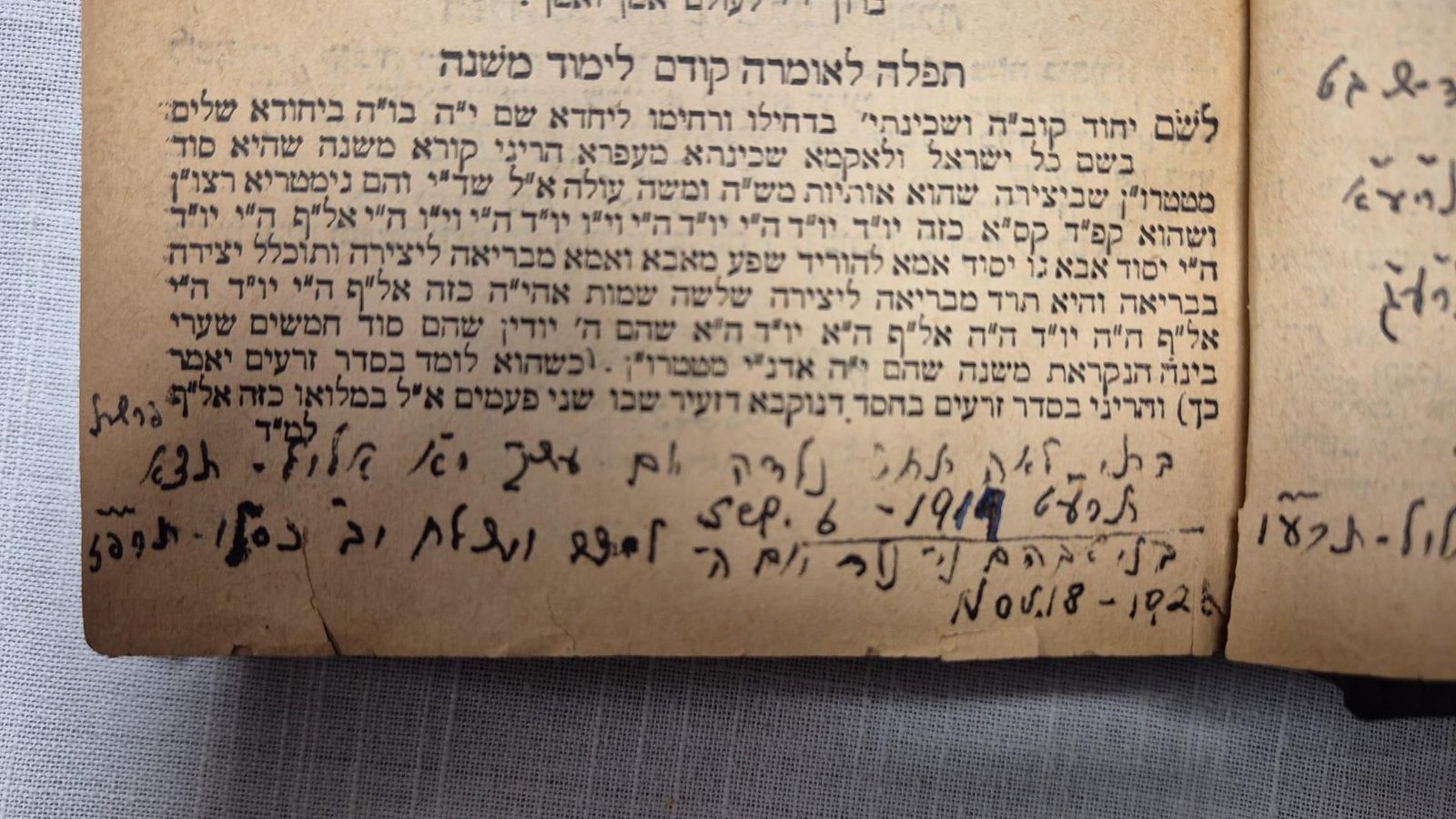
View the alternate photograph of Page 2

Reading the printed page
What surrounds the handwriting
The ethical instructions
The numbered passage above the earliest entries parallels the final section of Orchos Chaim attributed to the Rosh. Its visible counsels concern judging others favorably, seeking forgiveness and peace, guiding a household in prayer and blessings, studying the weekly portion, honoring Shabbos, assisting others and doing good modestly. The final word, סליק, means “concluded.”
תפלה לאומרה קודם קריאת נביאים
“A prayer to be said before reading the Prophets.” Only part of this section is visible at the top edge of the photographs.
תפלה לאומרה קודם קריאת כתובים
“A prayer to be said before reading the Writings.” The prayer asks for spiritual preparation for study and that sin or improper thoughts not impede it. It concludes with a request that the work of one’s hands be established.
תפלה לאומרה קודם לימוד משנה
“A prayer to be said before studying Mishnah.” It opens with an Aramaic declaration of intention to unite the Holy One and His Shechinah, in reverence and love, on behalf of all Israel. The following Hebrew passage gives kabbalistic correspondences for Mishnah and the order of Zeraim. This is printed study text, not part of the family record.
תפלה לאומרה קודם לימוד קבלה
“A prayer to be said before studying Kabbalah.” It declares the intention of study and asks for the purification of spirit and soul. The concluding phrase ברוך ה׳ לעולם אמן ואמן means “Blessed is Hashem forever; amen and amen.”
The adjacent blessing
The large vocalized text beside the Kabbalah page is part of the blessing after the Haftarah. Among the visible phrases are references to the Torah, the holy Shabbos, and the sanctification of Shabbos. Its beginning and ending are outside the photograph.
The explanations above describe and translate the visible headings and the function of the printed passages. They are not a complete transcription of cropped text or a translation of every kabbalistic Divine-name formula. Those formulas should be checked against a full, clearly photographed edition before a diplomatic transcription is published.
Research & attribution
Sources and editorial notes
- C. B. Weinfeld, “Majestic Matriarch—Mrs. Miriam Mendlowitz a”h,” Yated, February 12, 2014.
- Lewis Brenner, “Song of Faith,” The Jewish Observer, January 1978, pp. 20–21.
- Touro University, “Touro Talks: Jewish Life in Poland and Lithuania,” event listing for February 4, 2025.
- The Leiman Library, collection description.
- Shnayer Leiman, biographical entry; used for the reported parental relationship.
- Alexander S. Gross, biographical entry; records the conflicting 1917 birth year.
- Chok L’Yisrael, Bereishis, introductory prayers; parallel printed text, not proof of this copy’s identity.
- Orchos Chaim of Rabbeinu Asher, section 7; parallel to the ethical text on the first photographed page.
- Menhert Gross, Certificate of Naturalization, June 30, 1927; family-supplied scan.
- Rabbi Yehoshua Baruch Reinitz testimonials concerning Menashe Gross; family-supplied image, including printed caption.
- Kol Yaakov, Lemberg: F. M. Poremba, 1858; family-supplied title page and ownership stamp.
Primary sources: four photographs of the birth register supplied by Sender Gross, received from his uncle Shragi Gross; two additional images showing rabbinic documents and a book title page; and the supplied naturalization-certificate PDF. The attribution to Menashe Gross and the participants in the rediscovery come from Sender Gross. No interview quotations have been invented. Identifying a passage is distinct from identifying the physical edition.