Posted on — Leave a comment

    The View from Kemp Mill: A Conversation with Dr. Tevi Troy

    Dr. Tevi Troy at a cabinet meeting in the George W. Bush administration, with Interior Secretary Dirk Kempthorne, Deputy Secretary of State John Negroponte and President Bush

    A conversation with Dr. Tevi Troy

    From the White House to the neighborhood shul, presidential historian Dr. Tevi Troy reflects on Jewish continuity, the community he calls home, and the difference between political disagreement and intimidation.

    From the September 2026 Sukkos Edition · Read the original magazine feature

    There are plenty of ways to describe a Jewish community: its schools, its shuls, its housing prices, its kosher restaurants. In the middle of our conversation, Dr. Tevi Troy offered another.

    “People read books here.”

    It was a small observation, but it opened a much larger discussion about what Kemp Mill values—and what makes people choose to build their lives here.

    A presidential historian, former senior White House aide, and former deputy secretary of Health and Human Services, Troy has spent years studying Washington and working inside it. He is now a senior fellow at the Ronald Reagan Institute and a senior scholar at Yeshiva University’s Straus Center.

    For our third annual conversation ahead of the High Holidays, we began not in the Oval Office, but in the Gemara—with a question that would carry us through much of the discussion: What keeps a Jewish community together?

    From there, we moved closer to home: Kemp Mill’s changing character, its rabbis, its political differences, and, yes, its restaurant hours. We also discussed a book taking shape from his Talmud podcast contributions and his concerns about threats directed at Jews and public officials.

    Troy was speaking from Tacoma, Washington. At one point, he paused to admire the water: “I wish I could show you the view I have.”

    The view back home proved worth discussing, too.

    This conversation has been edited and reorganized for clarity and flow.

    Ancient questions, familiar concerns

    What does the Gemara tell us about keeping a Jewish community together?

    The Jews were trying to navigate a world in which they no longer had their own country, and foreign rulers made a real difference to their lives.

    That is part of how I see the Gemara. It is not just about Jewish law. It is also about how we are going to live in this new environment. Some Jews were in Babylonia; others were elsewhere. They had to deal with the Romans and the legacy of the Greeks. They were trying to cope with the chaos of the pre-modern world.

    These were practical questions. You are living under somebody else’s rule, and what that ruler decides can affect your community. So you have to understand the world around you. But you are also trying to maintain a Jewish life within it. How do you do both? That is part of what these discussions are working through.

    There is also the question that runs through the experience of exile: How do you hold things together? How do you maintain a Jewish community through all of that? The fact that we are still here is part of what makes the question so interesting.

    What makes a community work?

    Dr. Tevi Troy with the Justice Department’s antisemitism fighter Leo Terrell. Terrell is holding The Jewish Roots of American Liberty, to which Dr. Tevi Troy contributed an essay.
    Dr. Troy with the Justice Department’s antisemitism fighter Leo Terrell. Terrell is holding The Jewish Roots of American Liberty, to which Dr. Troy contributed an essay.
    Dr. Tevi Troy with White House colleague — and CNN contributor — Scott Jennings.
    Dr. Troy with White House colleague — and CNN contributor — Scott Jennings.

    What has stood out to you about Kemp Mill’s growth?

    The shifting demographics of the Montgomery County Jewish community. When I moved to Kemp Mill in 2002, it was not clear to me that it would become the area’s central Orthodox community. There were White Oak, Woodside, and Potomac, among other options.

    At the time, Kemp Mill struck me as a more Modern Orthodox community. Now it has become a place for a much broader range of Orthodox Jews, from modern to yeshivish. That emergence is interesting to me.

    I remember when a number of the Torah School rebbeim lived in White Oak. Over time, people moved to Baltimore or Kemp Mill. White Oak became a smaller community than it had been, while Kemp Mill grew substantially.

    So it is not just a question of the community getting bigger. It is also a question of who can see themselves living here. That has broadened quite a bit.

    What made that growth possible?

    A number of new shuls opened during the time I have been here, and they met different needs. That is an important part of the story, because an established Orthodox community does not necessarily have everything every Orthodox family is looking for.

    Chabad of Silver Spring is a good example. Some people initially wondered why Chabad was coming into an already-established Orthodox community. But they have done an amazing job and clearly filled a need. There were people looking for something different, and Chabad gave them that option.

    Ohr HaTorah met another need. You had yeshivish families who wanted a fuller family davening experience than they could necessarily have at the Yeshiva, where the focus is naturally more on the bachurim. A family looking for a shul has somewhat different needs, and having a place that recognizes those needs matters.

    You could look at Kemp Mill and say, “It is Orthodox. It has plenty of Orthodox shuls.” But having several shuls is one thing. Having a shul where a particular family feels comfortable is another. Even within an Orthodox community, people are looking for different things.

    Those additional institutions helped more families see Kemp Mill as a place they could make their home. So the growth of communal resources mattered. It helped broaden the community without requiring everyone to fit into the same mold.

    Dr. Tevi Troy with Tikvah’s Rabbi Hershel Lutch and top election lawyer Charlie Spies.
    Dr. Troy with Tikvah’s Rabbi Hershel Lutch and top election lawyer Charlie Spies.
    Three former Deputy Secretaries of HHS: Eric Hargan, Jim O’Neill and Dr. Tevi Troy
    Three former Deputy Secretaries of HHS: Eric Hargan, Jim O’Neill and Dr. Troy

    What draws families to Kemp Mill?

    We have friends who moved here from Boca Raton about five years ago. They had done research into which Modern Orthodox community would be the right fit for them. It was a combination of things, rather than any one thing that settled it.

    Where could their children get a strong secular education alongside a Jewish education? Where would the culture not be completely materialistic? Where would there be enough kosher options?

    Nobody is going to say that we lead in the number of kosher restaurants. We do not. But there is a difference between having every possible option and having enough of what you need. We did not always have kosher sushi. Now we have sushi!

    Then there are the other things: relatively more affordable houses, and a feeling that not everyone is competing to own the newest car.

    People read books here.

    That tells you something about the atmosphere. When you are choosing a community, you are thinking about schools and shuls, of course. But you are also thinking about what your children will see around them and what people value. What will seem important to them as they grow up here?

    Those things mattered to this family. The community had to meet a certain threshold: a choice of shuls, school options, enough kosher resources. You cannot simply substitute a nice atmosphere for the things a family needs.

    But once those needs were met, the other qualities became important, too. The question was no longer just whether the community had enough. It was whether this was the kind of place where they wanted to raise their children.

    So it’s not all about the restaurant count?

    Exactly. There is a lot to offer beyond the number of kosher restaurants. It is a nice community, and I have heard people at yeshivos and seminaries talk about how nice the Maryland kids are. That says something about the place, too.

    What gives the community that character?

    A couple of things. There are a lot of government employees here, so it is not necessarily a money culture. There is more of a government and public-service culture. I think that helps shape the atmosphere—what people value, what they are interested in, and what they talk about.

    The Washington area also has a substantial intellectual life, with think tanks and universities. And there is intellectual diversity within the community. You have liberals and conservatives—some of them professionally liberal or conservative. Politics is not just something they follow; it is what they do for a living.

    But there is a recognition that somebody else can have a different political perspective. You are not necessarily going to agree, and nobody is asking you to. You can disagree with someone and still be part of the same community.

    Growing up in my circles in New York, a Republican Jew was unusual enough that people would remark on it. My son’s experience in Miami is almost the reverse: he found a much more conservative environment.

    Here, you have a mix. The person sitting next to you in shul may see politics very differently from you. But you are still neighbors, and there is more to that relationship than where each of you stands politically.
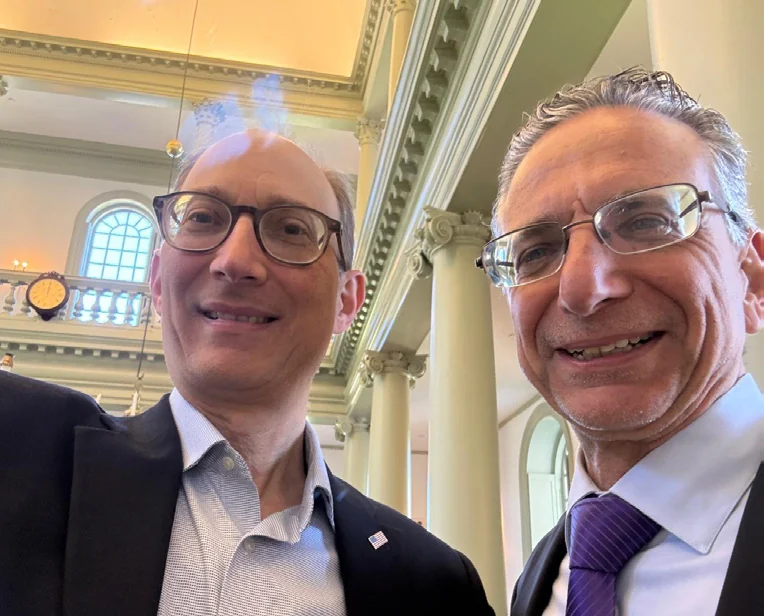
    Dr. Tevi Troy with author Joe Loconte at the Newport Synagogue in Rhode Island
    Dr. Troy with author Joe Loconte at the Newport Synagogue in Rhode Island
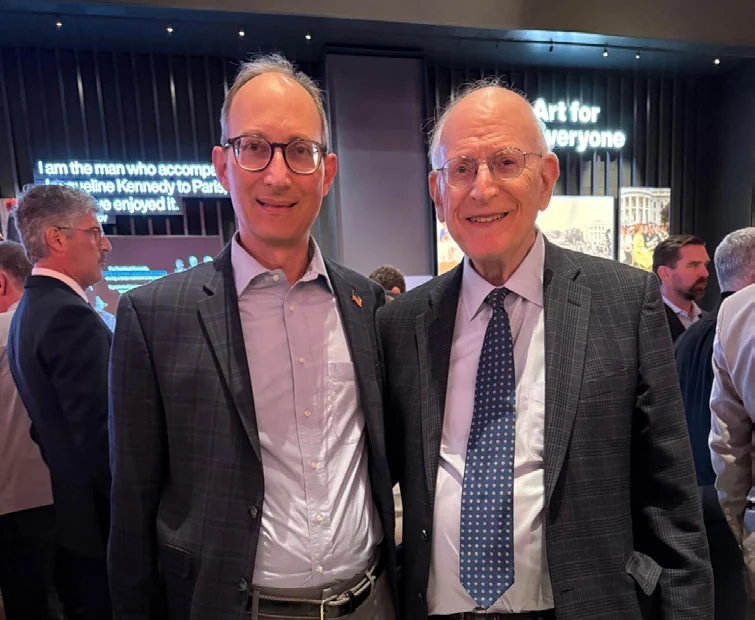
    Dr. Tevi Troy with former senior government official Ambassador Stuart Eizenstat
    Dr. Troy with former senior government official Ambassador Stuart Eizenstat

    So, is this a less competitive community?

    Competitive on other fronts.

    I am not sure “less competitive” is the right description. But the competition does not seem to be primarily about who has the newest car.

    What role do the rabbis play?

    We have some really special rabbeim.

    Look at Rabbi Wolvovsky and the program at Chabad that brings in rabbis from across the community to speak. He told me he had discussed the idea with people in other communities, and they could not put the same thing together. Some thought it would not work where they lived. Others looked into it but could not make it happen.

    It is interesting that Kemp Mill is a place where it does work.

    Rabbi Weinberg at KMS is another very special person. And my impression of the Vaad is that it recognizes different stripes of Orthodoxy and accepts that they can be part of the same community.

    Do people feel comfortable disagreeing politically?

    In my experience, yes. I do not feel the kind of ideological shunning over American partisan politics that I have heard about elsewhere.

    I had a non-Jewish friend in Kensington who was conservative. He told me that he and his wife felt socially excluded because of their politics, including among other parents. They eventually moved to North Carolina. That was his account of his experience. It is not what I feel here.

    Part of the explanation, I think, is that we are used to overlapping communities. In the broader Jewish world, Democratic affiliation is familiar. In Orthodox circles, conservative and Republican perspectives are familiar.

    Here, you encounter both. A different political affiliation does not automatically make someone an outsider.

    And when it comes to politics in shul?

    One good feature of the community is that there tends not to be partisan politics from the bimah. At KMS, that is a very strict rule, as I understand it.

    A lot of people here are professionally political. They do not necessarily want to hear politics in shul, whether it comes from the right or the left.

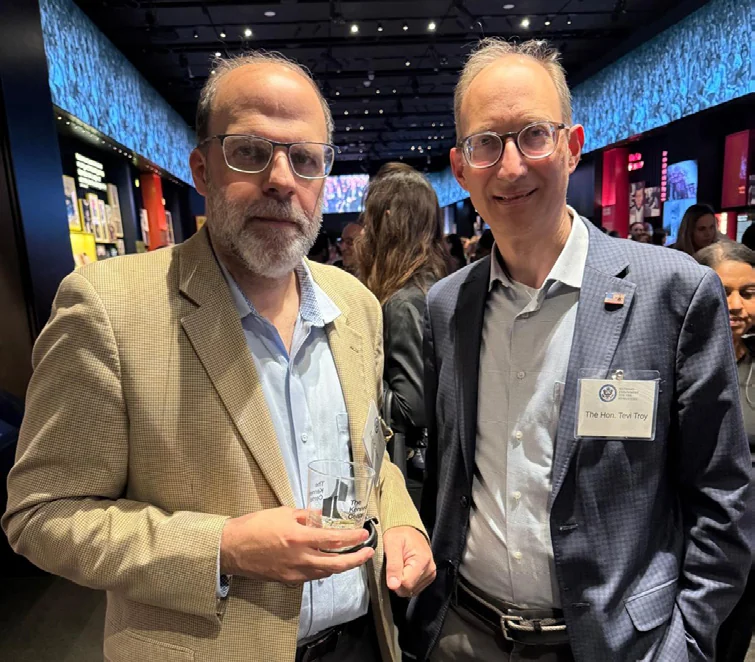
    Dr. Tevi Troy with authors Jonah Goldberg and Vincent Cannato
    Dr. Troy with authors Jonah Goldberg and Vincent Cannato
    Dr. Tevi Troy with Tikvah CEO Eric Cohen
    Dr. Troy with Tikvah CEO Eric Cohen

    You have debated this with Rabbi David Saperstein. Where did you differ?

    David is a friend, and we did a series of debates at shuls around the country. We have different perspectives.

    I argued for keeping politics out of shul. His position, as he explained it to me, was that political engagement could be part of what brings people into the pews. He was not shy about that. We disagreed about the role it should play.

    I grew up in a Conservative shul, and the joke was that rabbis took their sermon cues from The New York Times editorial page. I am not sure that approach would work in this community, and I think that is a good thing.

    The people can be political without the shul itself being partisan.

    Could the community expand a little farther out?

    I think we should look a little farther north, toward Randolph Road. There is housing stock there that may be less expensive than houses within a very short walk of the existing shuls.

    Perhaps there could be a neighborhood Friday-night minyan, with people making the longer walk to the established shuls on Shabbos morning. It is worth thinking about how that might work.
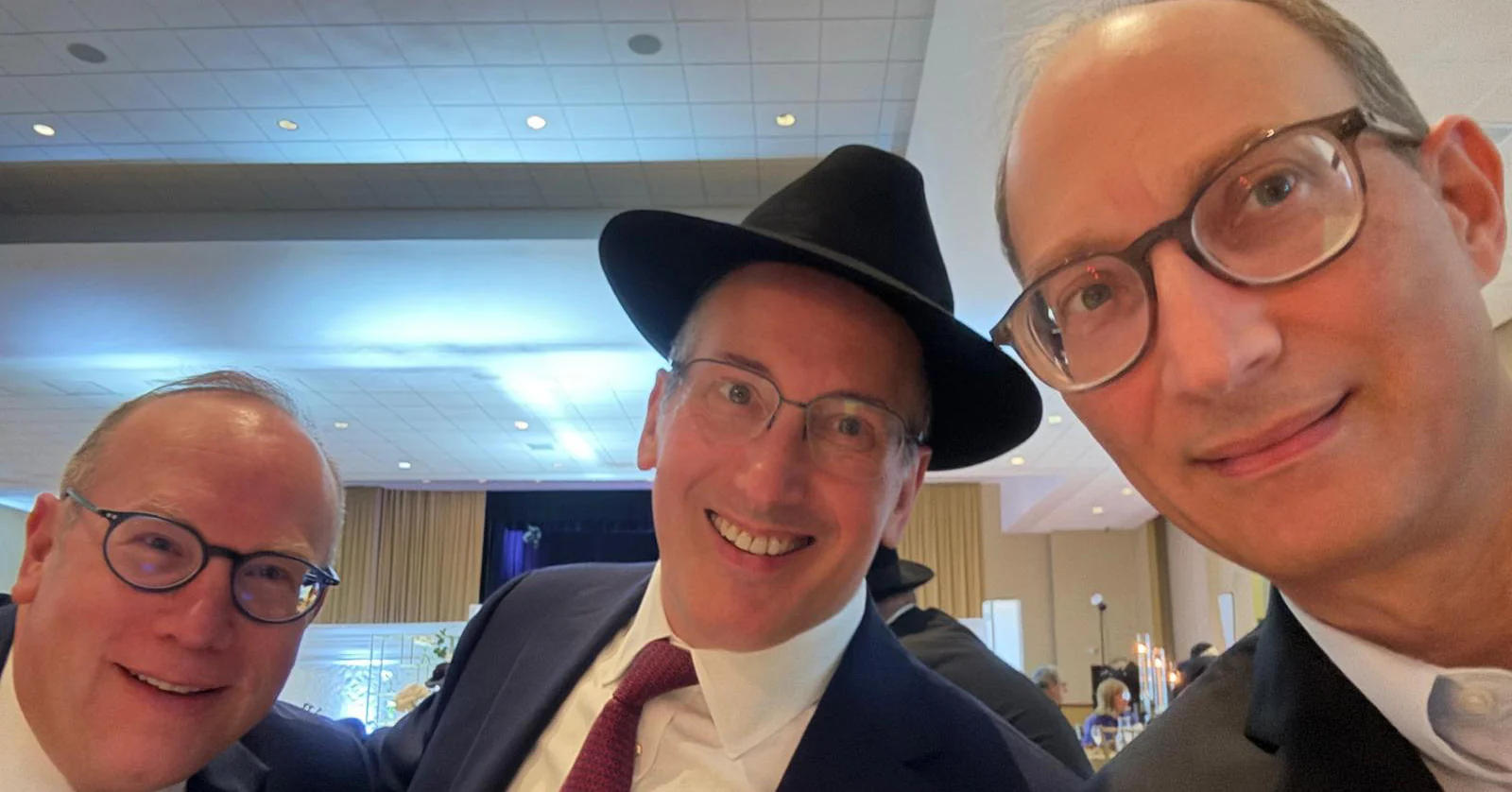
    Dr. Tevi Troy with close friends Chief Judge Matthew Solomson and Mars’ Jay Eizenstat
    Dr. Troy with close friends Chief Judge Matthew Solomson and Mars’ Jay Eizenstat

    Should we do more to introduce families to Kemp Mill?

    We have a lot to offer. There is a lot to tell people about. So yes, I think a more deliberate effort to market the community could be worthwhile.

    From the daf to the next book

    Let’s return to Take One. How did you go from listening to the podcast to becoming a recurring contributor?

    I started listening to Liel Leibovitz’s podcast, which brings in different writers and thinkers to discuss the Gemara. I thought it would be nice to participate.

    I was learning at a slightly different pace, so I could look ahead for something that might work. I pitched him an idea, and he liked it. I came on, and then it developed into a recurring thing.

    We made a bit of a shtick out of it. Liel is very good with nicknames, and that became part of the fun.

    When did you realize there might be a book in it?

    I have been doing these for about five years, and I am very glad, in retrospect, that I saved the scripts. I did not just speak off the top of my head.

    At one point, I put all the material together and realized I had something like 15,000 or 20,000 words. That was enough to make me think seriously about a book.

    I spent the summer working on the draft, and I am planning to submit it to the publisher soon.

    Do you have a title yet?

    Not yet. I considered using the podcast nickname, but I am not sure it is widely recognized enough to carry a book title on its own. I will find one.
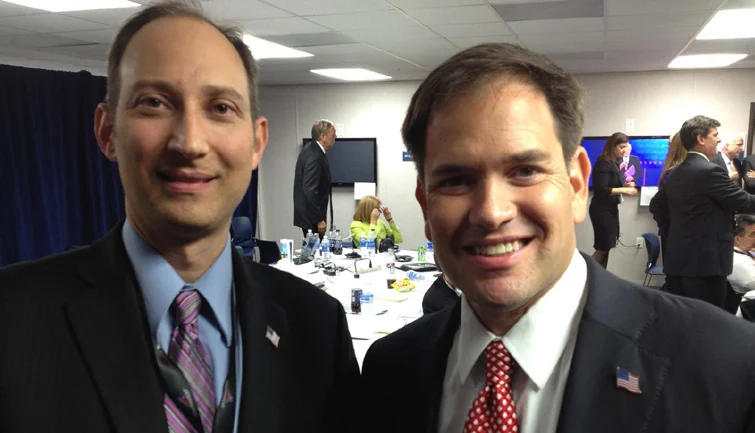
    Dr. Tevi Troy with then Senator Marco Rubio
    Dr Troy with then Senator Marco Rubio
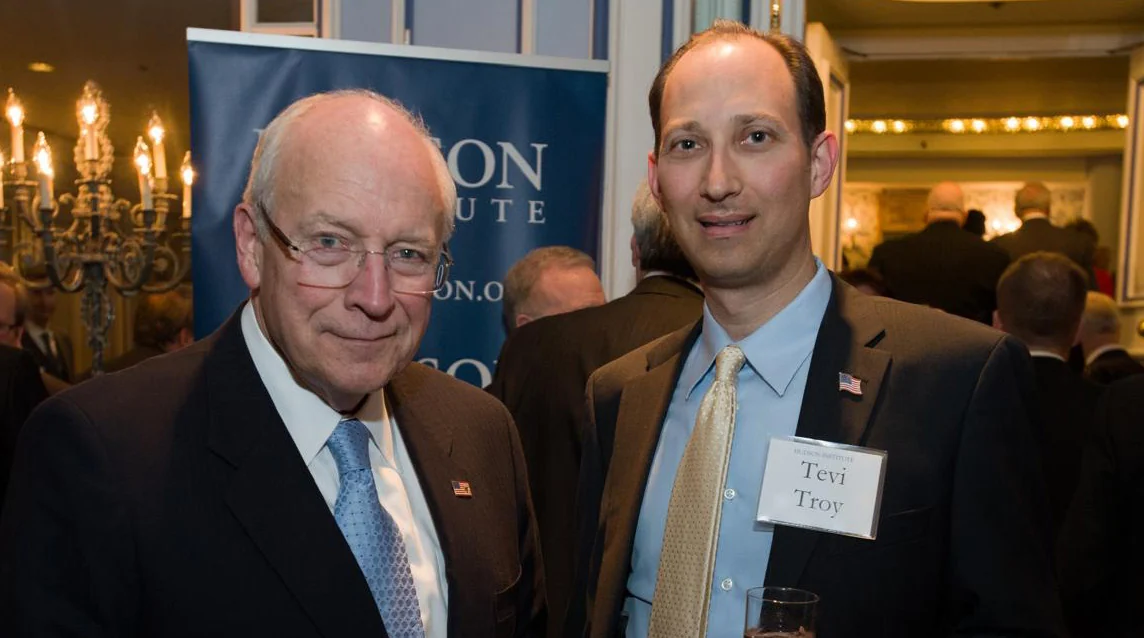
    Dr. Tevi Troy with former Vice President Dick Cheney
    Dr. Troy with former Vice President Dick Cheney

    You mentioned “underpromise and overdeliver.” Is that your approach, too?

    Definitely. Some people have a brasher approach. That has never been my way.

    Disagreement, pressure, and the public square

    What concerns you about the discussion around Israel—and what are your hopes for 5787?

    I am concerned about efforts by opponents of Israel to make it unpopular. In my view, those efforts have had an effect on the left, and I see hostility toward Israel on parts of the right as well.

    My hope for 5787 is that the Jewish community can begin to turn that around. I do not think we should assume that public attitudes are fixed.

    Why are you optimistic about changing that?

    Joshua Muravchik wrote a book called Making David into Goliath: How the World Turned Against Israel. You should talk to him.

    What struck me in reading it was his account of how much sustained effort, over many years, went into changing the way people viewed Israel. I came away thinking that this shift did not simply happen on its own.

    You could read that and say, “Woe is me.” But I am an optimist. My reaction was: If people were able to put thought, energy, and resources into changing perceptions in one direction, then we have people who can put thought, energy, and resources into changing them in another.

    That takes ideas and effort, and it takes money. But it is not just about money. It is about being thoughtful and deliberate about the case you are making.

    How much of the criticism is really about Netanyahu?

    Jared Moskowitz raised that question in an interview with Jewish Insider. He talked about colleagues who had explained their opposition to aid in terms of Benjamin Netanyahu, and his question was: What happens when Netanyahu is no longer there? Do those positions change?

    That is a distinction worth examining. Is the disagreement really with a particular Israeli leader, or does it go beyond that leader?

    There was another part of the interview that concerned me even more. Moskowitz talked about threats and harassment directed at members of Congress, and about how frightened some of their spouses are. He argued that concern about their families is becoming part of the political calculation.

    Dr. Tevi Troy is sworn in as Deputy Secretary of HHS by then-Judge Brett Kavanaugh, alongside his wife, Kami.
    Dr. Tevi Troy is sworn in as Deputy Secretary of HHS by then-Judge Brett Kavanaugh, alongside his wife, Kami.

    That seems like a very different kind of political pressure.

    It is. That was the part of his account that I found chilling.

    It is not only the member of Congress who has to deal with it. Their spouse is dealing with it. Their children may be dealing with it. Once that happens, you are talking about something very different from an argument over policy.

    The concern is that someone might begin thinking, “If I change my position, maybe the pressure moves on to somebody else.” That is very different from somebody persuading you that your position is wrong.

    So the question becomes whether people are free to act on what they actually believe.

    Exactly. The protection matters.

    There are outspoken supporters of Israel, including Ritchie Torres and John Fetterman, who are not Jewish. But my concern also extends to people who are less publicly identified with the issue and may still be facing threats against themselves or their families.

    I think that deserves more attention. A person should be able to make a decision based on what he or she actually believes, not based on fear about what might happen at home.

    You also connected this to what the Jewish community itself spends on security.

    The community is spending an enormous amount just to protect itself. A recent Jewish Federations of North America study estimated that American Jewish institutions spent more than $1 billion on security in 2025.

    Obviously, we have to protect our own synagogues, schools, and institutions. But alongside that, I think we should also be paying attention to the safety of legislators who are facing threats and to the safety of their families.

    If intimidation is affecting people’s ability to participate freely in public life, that is something the broader society has an interest in addressing.
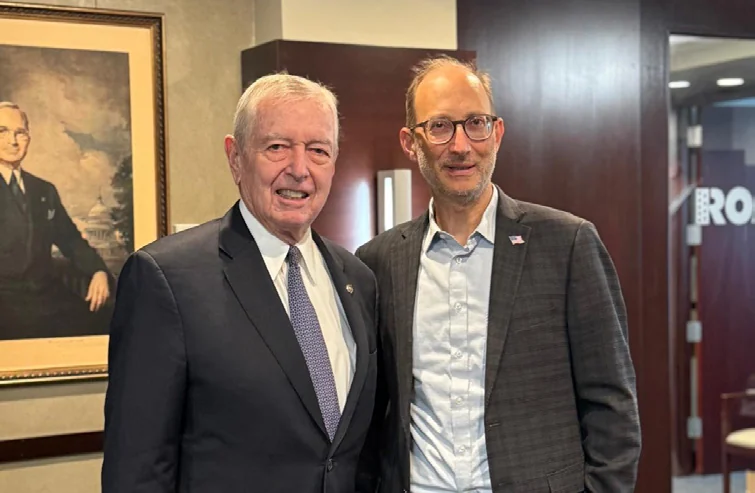
    Dr. Tevi Troy with former Senator and Attorney General John Ashcroft
    Dr. Troy with former Senator and Attorney General John Ashcroft

    You mentioned Tal Fortgang’s phrase “civil terrorism.” What does he mean by that?

    Tal has written about a kind of intimidation that is different from what people traditionally think of when they hear the word terrorism. He uses the phrase “civil terrorism” to describe unlawful conduct intended to coerce or intimidate people for political purposes.

    The distinction I would make is between expressing a view and physically targeting another person.

    You are allowed to say that you hate Israel. You are allowed to protest. But following somebody wearing a yarmulke and ringing a loud bell right next to his ear so that it causes injury is not simply making a political argument.

    That is the sort of conduct I am talking about. There need to be consequences for unlawful intimidation. People should not have to accept physical harm or targeted harassment as the price of being visibly Jewish or expressing their views.

    And for elected officials, the principle is pretty simple.

    Yes. They should be able to vote according to what they actually believe, not because they think changing a position might protect their family from threats.

    That is really the issue. Political disagreement is part of democracy. Intimidating somebody—or frightening his family— so that he changes his position is something else entirely.

    We’ll have to do this again when the book comes out. This is already our third High Holiday conversation.

    I would love to do a fuller interview when the book comes out.

    I love our conversations. I love the publication, and I look forward to these conversations going on for many years to come.


    Dr. Tevi Troy at a cabinet meeting in the George W. Bush administration, with Interior Secretary Dirk Kempthorne, Deputy Secretary of State John Negroponte and President Bush
    Dr. Troy at a cabinet meeting in the George W. Bush administration, with Interior Secretary Dirk Kempthorne, Deputy Secretary of State John Negroponte and President Bush
    Posted on — Leave a comment

    The Heart Behind Ben Yehuda Pizza

    Pizza with tomato sauce, mozzarella and basil, alongside fresh tomatoes.

    Kindness Behind the Counter
    From the June 2026 Summer Issue · View the magazine

    Some businesses become successful. Very few become part of the emotional fabric of a community.

    For more than two decades, Ben Yehuda Pizza has quietly been far more than a pizza shop for thousands across Silver Spring and Greater Washington. Behind the busy counter, late-night orders, and familiar slices is a place built on something deeper — quiet acts of kindness, community responsibility, second chances, fundraising efforts, hospitality, and countless moments most people never see.

    For this year’s Summer Issue of the Washington Jewish Journal, we sat down with owner Josh Katz for a thoughtful conversation about community, hospitality, hidden acts of chesed, growth, mozzarella sticks, and the deeper purpose behind one of Washington’s most beloved neighborhood staples.

    Ben Yehuda has become such a staple of the community. How did it all begin?

    It’s actually a really great story because Ben Yehuda was built specifically for this community. Back in 2000, Roger Kerlins, Steven Franco, and Ronnie Rosenbluth felt the Kemp Mill area needed something local — a pizza place people could walk to, something that felt connected to neighborhood life. At the time, there were kosher pizza options, but nothing that truly felt like it belonged right here in the center of the community.

    I was there from the very beginning. I was actually the first person officially hired by the founders, which is funny to think about now. The restaurant opened in the summer of 2000, originally for a private baseball team event for Roger’s daughter, but word spread quickly and people started showing up before we had even officially opened. In a way, the community opened the restaurant with us.

    A vegetable-topped pizza with melted cheese on a wooden serving board.
    A vegetable-topped pizza on a wooden serving board.

    That’s incredible — almost like the restaurant belonged to the community from day one. How did you eventually become the owner?

    It happened very naturally. Scott Schleslinger bought the business in 2008 during an incredibly difficult economic time and really strengthened the operations side of the restaurant. By 2012, he was ready to move on, and at the time I had been working in e-commerce for Sammy Franco.

    The opportunity came up, and honestly, it just felt right.

    I already understood what the restaurant meant to people. This was never just about pizza. Community pizza shops are different. People celebrate there, they bring their kids there after school, they stop in after shiurim or games or family events. There’s a responsibility that comes with that.

    So when I took over in May of 2012, the biggest thing for me was preserving that community-centered feeling while continuing to improve the business itself.

    You can really feel that community aspect when you walk in. Ben Yehuda seems to constantly support local causes and organizations.

    That’s always been important to us.

    We’ve done fundraisers for schools, organizations, and community causes over the years. One example was Noah Night Out at Max’s which helped support the Torah School. We try to look at these partnerships as a win for everybody involved — the institution benefits, the community comes together, and yes, it helps the restaurant too.

    Sometimes financially it may not even be the best decision on paper, but community businesses shouldn’t only think on paper.

    A fundraiser brings in new families, introduces people to the restaurant, creates positive experiences. That matters long term. If you’re part of a community, you have to actively participate in it.

    Josh Katz with a group including Montgomery County police officers outside Ben Yehuda Pizza in Silver Spring.
    Josh Katz of Ben Yehuda Pizza with Montgomery County’s finest outside the Silver Spring community staple.

    That mindset probably explains why people feel so connected to the restaurant. But at the same time, Ben Yehuda has also modernized a lot over the years.

    Absolutely — and honestly, that’s become one of the biggest focuses for us.

    I once attended a seminar where they said something that completely changed how I think about restaurants. They said your biggest competitor isn’t another restaurant. It’s the customer’s refrigerator.

    That’s so true.

    If ordering food feels complicated or annoying, people will just stay home and make something themselves. So our job is to make ordering as easy and seamless as possible.

    That’s why we changed our POS system, introduced the app, improved online ordering, and added self-service kiosks. We’re constantly trying to remove friction from the experience. People are busy. Families are busy. Convenience matters.

    That’s actually such a smart way to think about it. Are there plans to expand even further?

    We’ve definitely explored ideas.

    One thing we’ve been researching seriously is a movable pizza trailer concept. The idea would be to have flexibility — being able to serve different areas or events while still maintaining the Ben Yehuda quality and experience.

    The challenge with kosher restaurants is density. You need enough of a Jewish population concentrated in one place to support it consistently. Pizza is also different from something like shawarma — people will travel farther for certain foods than others.

    So expansion has to make sense operationally and for the community. We never want growth to come at the expense of quality in our current location.

    A cheese pizza cut into slices.
    A cheese pizza cut into slices.
    A tomato-topped pizza on a serving board surrounded by roses.
    A tomato-topped pizza surrounded by roses.

    Speaking of quality — people definitely have their Ben Yehuda favorites. What’s your personal order?

    I keep it pretty simple actually.

    Usually a smaller pie with thinner crust, light cheese, and green peppers.

    But one thing I always tell people is underrated is the Tony sauce. It’s a thicker sauce with a stronger tomato base and people who try it usually love it.

    We even tested changing sauces entirely at one point, but customers were very attached to the original. That taught us something important — consistency matters. People build emotional connections to food.

    And of course, the mozzarella sticks get a huge reaction from people, especially customers visiting from out of town.

    They’re hand-made with our own spice blend and people are genuinely shocked by how good they are.

    Breaded mozzarella sticks served with tomato dipping sauce.
    Mozzarella sticks with tomato dipping sauce.
    French fries in a red basket with a cup of ketchup.
    French fries with ketchup.
    Garlic knots in a basket with dipping sauce.
    Garlic knots with dipping sauce.

    What stands out most to you after all these years running the restaurant?

    Honestly? The moments that have nothing to do with pizza.

    The feedback that means the most to me is when customers compliment our staff for kindness or hospitality.

    There was one story that really stayed with me. A family came in one night and one of our employees, Ashley, noticed they seemed upset and emotionally drained. Without anyone asking, she offered the kids free ice cream just to brighten the mood a little.

    Later, the family sent us a letter explaining how difficult their day had been and how much that small gesture meant to them.

    That’s the stuff that matters most.

    Anybody can serve food. But hospitality — real hospitality — is different. We want people to feel cared about when they come in here.

    That really says a lot about the culture you’ve built there.

    The truth is the staff deserves most of the credit.

    The restaurant only works because of the people behind it every day. We have team members constantly looking for ways to help others — whether it’s donating supplies to food banks or helping organize community efforts quietly behind the scenes.

    There was even a fundraiser one of our assistants helped coordinate while she was literally in a bomb shelter in Israel. That level of dedication is humbling.

    And most community impact doesn’t happen through giant public campaigns. Usually it’s small acts. Quiet moments. Helping someone out when they need it.

    That’s really what we try to be about.

    “Anybody can serve food. But hospitality — real hospitality — is different. We want people to feel cared about when they come in here.”

    Josh Katz

    Last question — after all these years, what do you hope people feel when they think about Ben Yehuda Pizza?

    I hope they feel community.

    Of course we want them to love the pizza. But bigger than that, I hope they feel like Ben Yehuda is part of their lives in a positive way.

    This community supports local businesses in an incredible way, and we never take that for granted. If we can continue serving good food while also supporting people, schools, organizations, and families along the way, then we’re doing something meaningful.

    That’s always been the goal.

    Posted on — Leave a comment

    Flying With Faith: An Orthodox Jew’s Journey in the U.S. Navy

    Captain Joseph Cohn, retired U.S. Navy Medical Service Corps officer and neuroscientist.

    From the America at 250 · June 2026 issue
    View the complete issue

    Ilan Cohn sat down with Captain Cohn to hear his inspiring journey from neuroscience to naval aviation, overcoming challenges, embracing his faith, and serving with pride in the U.S. Navy.

    Captain Cohn’s career took an unexpected turn from the world of neuroscience to the cockpit of naval aviation. As an Orthodox Jew in the United States Navy, he navigated unique challenges, from keeping kosher to observing Shabbat while serving his country. In this exclusive interview, Captain Cohn shares his remarkable journey, the values that guided him, and his advice for other Orthodox Jews considering military service.

    Ilan: Captain Cohn, it’s an honor to speak with you today. Your journey—from the world of neuroscience to the cockpit of naval aviation—is nothing short of extraordinary. As an Orthodox Jew navigating the unique challenges of military service, your story is one that few have experienced. I’m excited to dive into your time in the U.S. Navy and hear how you balanced faith, duty, and adventure.

    Captain Cohn: It’s a pleasure to be here. Please, ask away.

    Tell me a little about your background before you joined the Navy.

    Originally, I was training as a neuroscientist at the University of Illinois. My main interests at the time were biology and math, so I completed a bachelor’s degree in biology. I wasn’t exactly sure what I wanted to do, so, like most people in my position, I applied to graduate school.

    I started a graduate program in immunology at Brandeis University, but I quickly realized I wasn’t interested in lab work and the traditional path of a biologist. Fortunately, I had an advisor who guided me through my uncertainty. He suggested that instead of leaving, I make a list of the top five things I was interested in. My list included math, biology, computer science, and robotics—that’s only four, but he took that and told me about a new neuroscience PhD program starting the next year. He offered me the opportunity to be one of its first graduate students, which was phenomenal.

    I pursued the program and focused on nonlinear dynamics—chaos theory—which was quite popular in the late ’90s. However, when it came time to do my postdoctoral research, I wasn’t sure if academia was the right fit for me.

    Navy Captain Joseph Cohn, at left in white uniform, addresses military medical researchers in El Paso, Texas, May 9, 2018.
    Navy Capt. Joseph Cohn, at left, speaks at William Beaumont Army Medical Center’s Research Day at Texas Tech University Health Sciences Center in El Paso, Texas, May 9, 2018. He was the Defense Health Agency’s research programs division chief. Photo courtesy of the U.S. Army.

    Clearly, you didn’t end up in academia. What motivated you to serve in the military? Was it a specific event, person, or value that drove you?

    Good question. I had been training my whole academic career to become a professor, and one of the purposes of a postdoc is to test yourself in an academic environment before fully committing. However, I realized I was not interested in academia. It wasn’t the long hours or the challenging problems that deterred me—I actually enjoyed those. Instead, I wanted to work on broader, more impactful issues rather than focus on a single, highly specialized theory.

    I strongly support academia and believe in the power of scientific research, but I felt there were other ways I could contribute to our country in a more immediate way. While searching for different career opportunities, I came across a Navy program that offered to send candidates to flight school and integrate them into the Navy aviation enterprise—provided they had a PhD in neuroscience or psychology. That caught my attention, and the rest is history.

    Tell me a little bit about flight school. What was your initial experience like when you joined?

    Before flight school, I had to attend Officer School. The type of Officer School I went to was designed for professionals with degrees or expertise that the Navy specifically needed—such as doctors, lawyers, physical therapists, and scientists. Our training was slightly different from that of “line officers,” who serve in combat roles.

    Because of my professional background, I entered with a mid-level officer rank and attended Officer Indoctrination School, which is a six-week program. It teaches the fundamentals of being a naval officer—military history, how to wear the uniform, and a phenomenal amount of physical training.

    Flight school itself was in Pensacola, Florida, the “cradle of naval aviation.” Both Officer School and flight school were incredibly exciting and unlike anything I had ever experienced. I was the only person out of 400 officers wearing a kippah. Fortunately, I met the school chaplain, Chaplain Carney, who approached me on my second day and asked how she could help make my experience more accommodating for my religious needs. She helped me navigate challenges, including observing Shabbat.

    For example, Officer School was in Newport, Rhode Island—home to the oldest synagogue in America. I asked if I could get a pass to walk there on Shabbat and spend the entire day at the synagogue. She made it happen, which was amazing. Similarly, in flight school, training was often 24/7, including evenings and weekends. However, I was able to request a “snivel” to avoid flying on Shabbat, and my superiors were very accommodating.

    Three U.S. Navy F/A-18 Super Hornets fly past USS George Washington in the Celebes Sea on November 29, 2025.
    Three F/A-18 Super Hornets from Carrier Air Wing 5 fly past USS George Washington in the Celebes Sea, November 29, 2025. U.S. Navy photo by MC2 Geoffrey L. Ottinger.

    How did you keep kosher while in training? I assume the meals they provided weren’t kosher.

    In Officer School, we ate meals together with our classmates, so my diet was limited to yogurt, fruits, vegetables, and various cereals for breakfast, lunch, and dinner. The moment I was allowed to leave base, I went shopping for kosher food.

    In flight school, I had more flexibility since I lived in my own apartment. My wife, Debbie, and I got an apartment on the beach in Pensacola, on a cliff overlooking the bay. Occasionally, we would drive to New Orleans to pick up kosher food.

    Were there other Jewish service members in your flight school class?

    Yes, there were other Jewish students in both Officer and flight school, and we definitely connected. However, I was the only Orthodox Jew. Most of the other Jewish service members were from Reform or Conservative backgrounds.

    Now that you’ve honorably retired, what do you consider your greatest accomplishment in the Navy?

    That’s a tough one. I would say my most rewarding accomplishment was during the last three years of my military career when I served as the specialty leader, or head, of my community.

    My specific naval community was aerospace experimental psychologists, which is part of a larger group called aeromedical officers. Our community consisted of about 30 members. Along with my assistant, I helped navigate significant personnel challenges, ensuring we retained the critical people needed to keep our community viable. I was proud to retire knowing I left behind a strong, capable team to continue supporting naval aviation.

    Looking back on your service, what lessons or thoughts stand out to you?

    Over time, I realized that the best way to guide my career, personal growth, and leadership development was by learning from the wisdom of my mentors. There were three key principles I carried with me throughout my career:

    1. Own your mistakes.
    2. Never lie, cheat, or steal.
    3. Excellence, not arrogance.

    These values shaped the way I served and led others.

    What advice would you give to Orthodox Jews considering a career in the U.S. military?

    The most important thing is to approach military service with a solutions-oriented mindset. I never went in saying, “I’m a religious Jew, and you have to accommodate me.” Instead, I would analyze the challenges ahead—whether it was standing watch on Shabbat or flight training conflicts—and find a way to balance my religious observance with my military duties.

    I always found a way to make it work, and my superiors respected that approach.

    Final question—would you recommend the Navy to other Orthodox Jews?

    It depends on the role. There’s a big difference between serving as a line officer in combat and serving as a staff officer in a specialized field. Staff officer roles—like mine—offer more flexibility to navigate religious observance.

    Before committing to military service, you have to be honest with yourself. Are you willing to go the extra mile to balance faith and duty? If you’re up for the challenge, the Navy offers an incredibly rewarding and diverse career path.

    President Donald Trump speaks with officials aboard USS George H. W. Bush during the Navy’s 250th anniversary visit, October 5, 2025.
    President Donald Trump speaks with officials aboard USS George H. W. Bush before a naval sea power demonstration, October 5, 2025, during the Navy’s 250th anniversary celebrations. Official White House photo by Daniel Torok.
    Captain Joseph Cohn, retired U.S. Navy Medical Service Corps officer and neuroscientist
    About the interviewee

    Captain Joseph Cohn, PhD

    U.S. Navy Medical Service Corps, retired
    Neuroscience · Naval aviation · Human performance

    From neuroscience to naval service

    Captain Joseph Cohn is a retired U.S. Navy Medical Service Corps officer whose work has connected neuroscience, aviation, military medicine and human performance. His 24-year Navy career included research, development and acquisition assignments across the Navy and Department of Defense. He brought a scientist’s understanding of perception and behavior to the practical challenges facing service members. SoarTech career profile

    Cohn earned a bachelor’s degree in biology at the University of Illinois Urbana-Champaign and a doctorate in neuroscience at Brandeis University, working with Dr. Jim Lackner. His doctoral research examined how visual illusions influence movement, exploring the relationship between sensory information, decisions and action. At Florida Atlantic University’s Center for Complex Systems and Brain Sciences, he completed postdoctoral work with J. A. Scott Kelso and Betty Tuller, applying nonlinear models to human cognition and behavior. Education and research background

    Research that reaches the people who serve

    His assignments extended from individual performance to large-scale research leadership. A University of Central Florida workshop biography describes his oversight of a joint team charged with combining more than $3 billion in military medical research, development and acquisition assets within a Defense Health Agency-led organization. It also records his co-leadership of a $20 million U.S.–India cognitive science and human performance collaboration and his work on selecting operators for unmanned aerial systems. UCF workshop biography, 2024

    In May 2018, Cohn addressed William Beaumont Army Medical Center’s Research Day in El Paso as the Defense Health Agency’s research programs division chief. The Army’s account describes his emphasis on connecting clinical investigators’ ideas with larger research programs, developing useful products and putting successful work into the hands of health care professionals. The event brought together resident and faculty projects across military medicine. U.S. Army report, May 21, 2018

    Education, innovation and life after the Navy

    Education also became a substantial part of his service. As the Office of Naval Research’s first deputy director for Naval STEM, he coordinated a program spanning all 50 states and reaching 200,000 students annually. His professional record includes more than 100 co-authored publications and three co-edited textbooks. He is a Fellow of the American Psychological Association and the Society of Military Psychologists, and an Associate Fellow of the Aerospace Medical Association. UCF professional profile

    An example of that educational work appeared in the Office of Naval Research’s 2013 announcement of Exploration Now. The initiative connected students and teachers with oceanographers through live research broadcasts and opportunities to speak with crews at sea. Cohn described the value of opening a direct window into scientists’ work, helping students encounter research as it happened. Office of Naval Research, June 20, 2013

    After retiring from the Navy, Cohn joined SoarTech, where his work has focused on human-centered technology and military medical readiness. Away from work, his interests include hiking in Maryland and Virginia and rock climbing, which he took up during flight school. SoarTech profile

    In this WJJ interview, Cohn reflects on the personal side of that career, including wearing a kippah in officer training, arranging for Shabbat observance, finding kosher food and leading the Navy’s aerospace experimental psychology community. His account gives readers a firsthand perspective on the daily choices involved in combining Orthodox Jewish life with military service.

    Explore the America at 250 issue

    Posted on — Leave a comment

    The Makor College Experience: A Dream Come True

    Four Makor College Experience graduates celebrating in blue caps and gowns in 2026.

    From the June 2026 issue of Washington Jewish Journal.

    Shua Hoffman moved with his family from Silver Spring to Monsey, New York five years ago. While he loved his 21 years living in Maryland, his family moved for greater access to services for people with specialized needs. That brought Shua to the Makor College Experience where, last week, he marched down at Arthur Ashe Stadium with his peers at Yeshiva University’s 95th Annual Commencement.

    The Makor College Experience is a four-year, non-degree program for young men with Intellectual Disability on the Wilf campus of Yeshiva University in New York. The program provides individuals with Intellectual Disability the opportunity to be part of the YU community while gaining skills and exploring opportunities as they transition to lives of independence.

    “Yeshiva University is so much more than just a yeshiva or just a college. For many, it is the next stage in their lives as members of the Jewish community, a stage that, until we opened ten years ago, people with specialized needs were excluded from,” says Dr. Stephen Glicksman, founder and director of the Makor College Experience. “We recognized that while our participants’ cognitive challenges are disabling when it comes to the academic parts of college, they are not disabling for all of the other parts of college like campus life, joining clubs, and making friends.”

    The Makor College Experience

    The Makor College Experience is technically a “Day Habilitation Without Walls” program operated by Makor Care & Services Network, a lifespan social services organization supporting individuals with Intellectual and Developmental Disabilities since 1978. Makor approached Yeshiva University with the idea of opening a college experience program and the two institutions have worked in partnership to make this program a reality.

    While inclusion is an important part of the program, developing a healthy self-identity is also a major aspect of participants’ growth throughout their four-year stay. As Dr. Glicksman puts it, “We want the inclusion to be real. We aren’t a chesed program. That’s why we have our own shiur in the morning, and our own classes in the afternoon. That way, when our guys join the rest of YU at the gym, at a club, learning in the Beit Midrash, or just hanging out, they can join their peers as equals because, in those contexts, their diagnoses don’t necessarily impact their capabilities to the same degree they would in an academic setting.”

    “A dream come true”

    For Shua, the Makor College Experience is, as he puts it, “…a dream come true. I love the program, because it’s made me realize my potential and what I can give to the world. I love the Torah classes, and all the people I’ve met. I take music with Mr. Meth and he helps me with composing and brightening the world through song. I’ve learned how to be a leader. I love living in the Makor apartments and bonding with the guys. It has really helped me become more independent. In psychology class, I’ve learned skills for getting along better with people without blowing things out of proportion. Some things are still a challenge for me, but I see how much I’ve grown. All of my teachers are the best of the best. All in all, it’s been a great journey and a great four years!”

    Shua’s parents agree: “Makor has given Shua the ability to tap into his strengths and to be able to also be in touch with reality, which has helped him grow into a more mature and productive person. We are very appreciative of the entire staff for what they’ve done and being able to help Shua become that confident person he is.”

    As for Shua, his advice for those looking to grow, either within the Makor College Experience or wherever you happen to find yourself, is, “Take one day at a time, and strive for greatness. You should be matzliach and I hope all goes well!”

    To support or learn more about the Makor College Experience, please contact Dr. Stephen Glicksman at sglicksman@makords.org or 347-390-1315.
    Posted on — Leave a comment

    One Parent, One Letter, and the Power of Showing Up

    Editorial illustration of a letter, pen, car keys and a child’s knitted hat, with a family car outside the window.

    Every summer, an average of 37 children in America die in hot cars, forgotten in the back seat for a single terrible moment. These are not neglected children or negligent caregivers, these happen in regular families who love their children and do their best to protect them. Every one of these deaths is preventable and the technology to prevent them already exists.

    In many new higher-end car seats, the car seat buckle, when closed, detects the child’s presence and can even measure temperature. An app on your phone connects to it. If the child is left in a vehicle (i.e. the caregiver’s phone goes out of range of the car), it sends escalating alerts to the caregiver’s phone and, if ignored, to the emergency contacts. The same happens when the child has an unsafe rise in temperature. This technology needs to become the standard.

    I am a mother and a grandmother, not a lobbyist or a policy expert. After hearing of the most recent incident in Los Angeles, I simply could not stop thinking about this issue, so I did what any of us can do: I started writing letters.

    I wrote to the National Highway Traffic Safety Administration, the federal agency that regulates vehicle safety, proposing that child detection and temperature alert technology be built directly into car seats, not just vehicles. A car seat travels with every child regardless of what car they ride in. A simple Bluetooth sensor, a buckle detector, and an escalating smartphone alert could ensure no caregiver ever unknowingly walks away from their child again.

    I wrote to both Maryland senators, to Senator Blumenthal, who authored the HOT CARS Act, to my House representative. I contacted child safety organizations nationally. None of this required special access or expertise. It required only that I care enough to sit down and write.

    I am sharing this because grassroots change begins exactly this way, with one constituent and one letter, one conversation at a time. If this issue moves you, please write your own letter, your voice matters more than you think. I am attaching a sample letter that you can use to contact your representative.

    * I want to stress that no technology can fully prevent tragedies. Technology is only as good as the people using it. It is always important to remember to check the back seats in your car. If you have small children, make this a habit in all seasons. There are many other safety measures to put in place to keep children safe. Make sure to tell your child’s teacher to call you if your child doesn’t arrive at school or playgroup as expected. Make it a habit to text or call your partner or a family member when you drop off the kids each morning, confirming that everyone arrived safely. Simple steps become habit when done every time you leave a car.

    Template Letter: Child Car Seat Safety

    Send to Your U.S. House Representative

    How to use this letter

    Find your representative ↗

    Personalize your letter

    [Today’s Date]

    Fill in your representative’s name – find it at house.gov using your zip code.

    The Honorable [Representative’s Full Name]
    U.S. House of Representatives
    Washington, DC 20515

    Re: NHTSA’s Overdue Hot Car Rulemaking and the Case for Car Seat-Integrated Child Detection

    Dear Representative [Last Name],

    My name is [Your Full Name], and I am a constituent writing from [Your City, State, Zip Code]. I am reaching out about a child safety issue that I believe demands Congressional attention: the ongoing failure by the National Highway Traffic Safety Administration (NHTSA) to fulfill a mandate your colleagues passed into law.

    OPTIONAL – Personalize here. You might mention that you are a parent, grandparent, childcare provider, or pediatric healthcare worker. A sentence about why this issue matters to you personally makes your letter significantly more powerful. Example: “As a parent of young children, the thought that a simple, affordable technology could prevent these tragedies, and is not yet required, is deeply troubling to me.”

    [Optional: Add one or two sentences about your personal connection to this issue – e.g., your role as a parent, grandparent, or childcare worker, and why this matters to you.]

    An average of 37 children die from vehicular heatstroke in the United States every year. These deaths are predictable, and they are preventable. The technology to prevent them already exists.

    Congress recognized this in 2021. The Infrastructure Investment and Jobs Act directed NHTSA to finalize rules requiring rear occupant alert systems in all new passenger vehicles by November 2023. After missing the initial deadline, a revised agency estimate of April 2025 was also missed. As of today, NHTSA has not published even a preliminary proposed rule. Meanwhile, children continue to die.

    I am writing to ask two things of your office:

    1. Please formally inquire with NHTSA Administrator about the status of this overdue rulemaking and press for a firm, public timeline for its completion.
    2. Please consider supporting a complementary measure: directing NHTSA to study and develop safety standards for child-presence detection systems integrated directly into car seats themselves, not only into vehicles.

    This second point matters because vehicle-based systems, even when mandated, will leave critical gaps:

    • They are absent from the millions of older vehicles already on American roads.
    • They fail when children enter a car independently, a scenario accounting for approximately 25% of hot car deaths.
    • Six documented hot car deaths have occurred in vehicles already equipped with reminder systems.

    A car seat-integrated alert system using widely available Bluetooth technology, buckle sensors, and escalating smartphone notifications, would travel with the child regardless of what vehicle they are in. It works in an older car, in a rideshare, or with a substitute caregiver. It is a portable, universal layer of protection that no vehicle mandate alone can provide.

    The technology is not theoretical. It is already commercially available in some car seats today. What is missing is a safety standard that ensures it works consistently, alerts escalate appropriately, and all children benefit from it, not just those whose families can afford premium seats.

    Congress passed the law yet NHTSA has not acted. I respectfully ask that your office help ensure the agency fulfills its legal obligation and considers going further to close the gaps that vehicle-based systems alone cannot address.

    Thank you for your service to our community and for your attention to this urgent matter.

    Respectfully,

    [Your Full Name]
    [Your Address]
    [Your City, State, Zip Code]
    [Your Phone Number]
    [Your Email Address]

    This template letter was created by Rochel Rabinowitz, Silver Spring, MD, as part of a citizen advocacy effort to advance car seat-integrated child detection standards. Please share freely.

    View original letter
    Posted on — Leave a comment

    Together Apart: A Patchwork of Achdus

    The completed 62-canvas community mural at Ben Yehuda Pizza, with colorful Kemp Mill houses and Washington landmarks.

    If you’ve eaten at Ben Yehuda Pizza anytime over the past six years, chances are you’ve seen the mural on the back wall.

    You may have noticed its bright colors. You may have searched for the section your family painted. Or perhaps it simply became part of the landscape—so familiar that after a while you stopped noticing it.

    Soon, after nearly six years on the wall, the mural will be retired and replaced with a new work of art. Before that happens, it’s worth taking a closer look at what has been hanging there all this time. More than just a mural, it became a record of a community and a snapshot of a moment when we were apart, yet still found a way to create something together.

    Back in 2020, when the world had become very small, schools were closed. Shuls were quiet. Playdates vanished. Simchas moved to screens. We waved to friends from across sidewalks and driveways.

    That was when Josh Katz, owner of Ben Yehuda Pizza approached me about creating a mural for the restaurant. Rather than paint it myself, we came up with a different idea: what if the community painted it together?

    I sketched one large neighborhood scene across 62 separate canvases. Then I broke the image apart, canvas by canvas, labeling each section with colors like a giant paint-by-number puzzle. Families received a kit containing a canvas, brushes, and six paints: red, yellow, blue, black, and white.

    Talya Weinberg’s original numbered sketch for the 62-canvas Ben Yehuda Pizza community mural.
    The original sketch on paper

    Each family painted its section in its own way. Some were careful. Some were bold. Some were neat. There were assorted patterns painted throughout, and the unmistakable evidence of children being handed paint and permission.

    One by one, the canvases came back. As they arrived, I pieced them together, outlined the mural in black, added some cars, people, and a few special details requested by Josh (Go Caps!), and slowly watched dozens of individual artworks become one unified picture. What looked random on a single canvas suddenly made sense as part of a larger scene.

    Colorful canvases painted by local families laid out to form the Kemp Mill neighborhood mural for Ben Yehuda Pizza.
    Laying it all out & putting it together.

    When the mural finally went up at Ben Yehuda, it was exciting to see all of the pieces patchworked together for the first time. What had started as 62 separate canvases, painted in 62 different homes, had become one colorful neighborhood scene stretching across the wall.

    Artist Talya Weinberg on a ladder installing the community mural, with Ben Yehuda Pizza owner Josh Katz helping at right.
    Hanging it up.

    As America prepares to celebrate its 250th birthday, I find myself thinking about the patchwork quilts that have become such a recognizable part of American history. Individual pieces, stitched together by many hands, create something larger than any one person could make alone. Looking at the mural today, it’s hard not to see a similar idea at work.

    There is something deeply Jewish about this idea as well: Chazal teach, “כשם שפרצופיהם שונים כך דעותיהם שונות”—just as people’s faces are different, so too are their minds and opinions different. Human difference is not a problem to be solved. It is part of Hashem’s design. The work of community is not to erase those differences, but to weave them together into something larger than ourselves. This is true achdus.

    Perhaps that’s why the mural has remained meaningful for so many people. It wasn’t just the finished artwork people remembered but the process. Families painted their small section without knowing exactly how it would fit into the final picture. Only when all 62 canvases came together did the full image emerge.

    Soon, the mural will make way for a new painting. Before it comes down, stop by and spend a few minutes with it. Look for the careful sections and the wild ones. Look at the mural not simply as a mural, but as a group photograph taken during a time when no group photograph was possible. The mural was born during a season of separation. For nearly six years, it has quietly reminded us of connection.

    That’s a pretty good run for 62 canvases and a pizza shop wall!

    Posted on — Leave a comment

    Darkness: Concealment and Contrast

    Editorial portrait of Rabbi Ahron Lopiansky beside glowing Chanukah oil lamps.

    I. Concealment

    And the earth was empty and without form, with darkness covering the abyss.

    Bereishis 1:2

    The story of Creation begins with a prelude — the enumeration of four states of imperfection that were present in the universe at the moment of Creation: tohu (empty), vohu (without form), choshech (darkness), and tehom (abyss).

    The Maharal (Ner Mitzvah) explains that these four states of imperfection are not incidental deficiencies that merely happened to become manifest at the time of Creation. Rather, they are intrinsic to the process of creation itself. Every created being, explains the Maharal, is by its nature limited and imperfect. Only the Creator is perfect, boundless, and limitless. These four “imperfections,” then, are not limited in time to the dawn of creation, nor to the four states mentioned above. Rather, they constitute the antecedents of every evil and fault in all of its dimensions — personal, national, and historical — that manifest themselves during the entire duration of the created world.

    The Midrash Rabbah demonstrates how these four flaws have made their appearances throughout history, most prominently under the dominion of the four kingdoms that dominated world history — as revealed to Daniel in a dream — leaving their impact upon mankind for generations to come. These are the empires of Babylon, Persia, Greece, and Rome. Each empire was a national and cultural embodiment of one of these four dimensions of evil: tohu denotes Babylon, described in sefarim as the embodiment of self-deification and egoism; vohu signifies the unrestrained hedonism of Persia; choshech represents the so-called intellectual enlightenment of Greece; and tehom, the seemingly interminable wicked domination of Rome.

    Upon closer examination of the midrash’s pairing together of symbol and nation, we notice a subtle difference between the characterization of Greece as darkness and the dimensions of evil attributed to the other empires. The other evil traits can be considered as resulting from a lack of perfection and godliness, the shortcomings of an incomplete and as yet unformed world; darkness, by contrast, is different. It is a “positive” dimension — an object of creation — purposefully introduced into the universe. Rashi (Pesachim 2a) also makes this point clear. He explains darkness, not as an absence of light, but as a positive force that “darkens” the world, so to speak. Indeed, a pasuk in Yeshayah (45:7) declares God to be “yotzer or u’vorei choshech” (He who forms light and creates darkness). Darkness was indeed created.

    If this distinction between darkness and the other flaws of creation exists on the metaphysical plane, it must also be evident in its human and national manifestation: Greece as compared to the other powers. How does one understand the cultural essence of Greece as a positive yet destructive force? What distinguishes Greece’s trait of wisdom or philosophy from the identifying traits of Rome, Persia, and Babylon?

    Perhaps one can begin by noting how Greece’s national character, i.e., Greek philosophy or wisdom, relates to Israel. While idolatry, hedonism, and imperialism are totally alien to the Jewish national character, wisdom is an attribute shared by the Jewish nation. True, our wisdom, Torah wisdom, is on a plane of its own (as in Devarim 4:6: “For it is your wisdom and understanding in the eyes of the nations”); theirs, by contrast, is a superficial or external wisdom. The common denominator of wisdom, however, is unmistakable. No such common ground is shared by Israel and the other kingdoms in regard to their traits of idolatry, hedonism, or subjugation of others.

    Chazal point out the relationship between Greece and Israel in the pasuk, “God shall endow Yefes with beauty, and he will dwell in the tents of Shem…” (Bereishis 9:27). The beauty of Yefes will find its place in the tents of Shem. In the historical sense, this was realized in the translation of sacred texts into Greek (the Septuagint), the incorporation of elements of the Greek language into the Oral Law, and the use of Greek philosophy by many rishonim (such as the Rambam) to explain and illustrate many concepts of Torah. No such relationship was established with any other empire or culture.

    Yet, despite this seeming affinity, Greece is the only empire that Israel succeeded in fighting and overpowering. Babylon disintegrated on its own. Israel avoided the Persian decree of total annihilation. And our attempt to rid ourselves of Roman domination failed. It was only the rule of Greece that we challenged and were able to vanquish. What, then, is the essence of this Hellenism, so tantalizingly similar in character to Israel, yet so apparently opposed to everything Israel represents? What is the Grecian beauty that can adorn the tents of Israel? What is its sinister darkness, which will be overcome by the light of Mashiach?

    II. Dawn of Darkness

    A day that is neither day nor night.

    Passover Haggadah, based on Zechariah 14:7

    A human being perceives the world around him through his senses, each of which conveys a different type of information. The clearest and most vivid sense is that of sight, for while other senses provide limited data, vision gives one the feeling of total perception and cognizance. Thus, “seeing is believing.” Other senses give the feeling of knowing about the object in question; sight focuses on the object itself.

    It is this concept of light and vision that we must bear in mind when discussing the light and darkness of Creation. Were Creation fully illuminated and were we to actually perceive the Omnipresent and Omniscient Deity, there would be no room for self-perception as independent beings: “כי לא יראני האדם וחי — For man cannot see Me and live” (Shemos 33:20). The only feasible way for humanity to retain a semblance of independent existence, with the possibility of free will and constructive potential, is with the introduction of a veil of darkness, which effectively conceals the Divine radiance.

    What is this “darkness”? Where do we encounter it? It is what is commonly referred to as nature — the laws, concepts, and formulae that dictate and run the universe. Within this framework, the Divine Being is neither visible nor apparent; rather, it is the natural order of events that seems to bring sensibility to our examinations of the universe. Cause and effect replace Divine will.

    Greece plunged headlong into this darkness. It is wisdom, indeed, but a wisdom of the external world, divorced from the essence of Creation and denied of its association with the Divine. Taken as such, the darkness becomes an end unto itself; or worse yet, it is mistaken for light. As it says: “Woe to those who define darkness as light and light as darkness” (Yeshayah 5:20).

    Israel, on the other hand, examines this same darkness and uses it as a means of discovering the very light it is meant to conceal. When one carefully examines a veiled countenance, one can obtain some idea of the existence of a force or substance behind the veil. As the Zohar (parashas Emor) states: Even the person not informed of the secrets of the Divine may discern them by carefully studying the external universe and extrapolating to the internal universe. The complexity of nature, human drives and psychic composition, the patterns of history — these can all lead man to a glimpse of what lies beyond the obvious, to a bit of an inkling as to how hashgachah (Providence) conducts the affairs of the world. Even the Torah, which is the direct word of Hashem, is clothed in the fabric of nature: it discusses topics such as oxen goring one another and marriage and divorce. Yet these mundane concerns express cosmic truths and convey deeper spiritual concepts.

    Darkness, then, serves as a metaphor for the concealment of the Divine in the universe. In addition, several specific incidents recorded in the Torah refer to darkness in its literal sense as masking Divine revelations:

    • At Sinai, the mountain was enveloped in three increasingly dense layers of cloud. In order to receive the luchos, the Tablets of the Law, Moshe was required to step into the “thickest and densest” layer of the three (Shemos 19:9, Rashi).
    • Aaron’s children, Nadav and Avihu, were guilty of gross conduct at Sinai described as, “ויחזו את האלקים ויאכלו וישתו — They gazed at God, and they ate and drank” (Shemos 24:11), meaning they feasted their eyes, so to speak, on the glory of God. Their punishment was death. Aaron was consequently commanded to bring incense into the Holy of Holies before entering that area on Yom Kippur. The incense would burn and form a cloud so clear perception would no longer be possible; rather, “In a cloud will I appear on the Ark” (VaYikra 15:2, Yalkut Shim’oni).
    • When Moshe Rabbeinu was ensconced in the nikras hatzur (the crevice of the rock), God covered the entrance to Moshe’s cave so he would not be blinded by the Divine radiance (Shemos 33:22).

    Darkness represents the mechanism of nature designed to conceal and disguise the Creator, Who is continuously directing and conducting the affairs of the universe. Yet every Jew can utilize this very system as a means of achieving personal growth by gaining a more profound understanding of God. This, then, is the natural progression of learning to detect God within creation. Initially all is seen as impenetrable darkness; only later does the light of day become apparent through this darkness.

    III. Contrast

    The elementary understanding of the concept of darkness is that it is like a cloak, concealing the Divine presence and radiance to allow man free choice and a meaningful existence as an independent being. But the full meaning of this concept is far deeper. Darkness is actually a prime element of sight, as we will demonstrate. It is in this context that we understand the concept of beauty as it expresses itself in Greece. Not only does darkness suggest a dimming of the Divine illumination, it simultaneously makes us aware of the illumination.

    Aside from providing a background for observation, darkness is an integral element of sight, for the eye distinguishes shapes through the medium of contrast. An area that is monoluminous and monochromatic contains no visual information. We are able to see a picture by discerning between lighter and darker areas and different shades of color. Thus, “sight” is the perception of the contrast between light and darkness. Eliminate darkness, and light becomes as meaningless as well!

    The Ramchal, in Da’as Tevunos (sec. 34), uses a similar concept to explain that our understanding of God refers solely to the attribute of unity. Why is this so? Because no other attribute can be understood or defined by negating its opposite. For example, lack of stupidity does not imply intelligence, lack of weakness does not define strength, nor does “not ugly” describe beauty. Achdus (oneness), however, can be defined as “not multi-.” True, we may not perceive God’s unity in its essence, but we can sketch its parameters (for the person who believes in Divine forces) by negating polytheism. Having defined the set “not A,” we have adequately defined “A.”

    This gives us a new insight into the pasuk: “And God saw the light that it was good, and He divided between the light and darkness” (Bereishis 1:4). Since light and observation are good, one needs the distinctive focus and contrast of light from darkness for them to be fully appreciated. A totally gray picture is meaningless. On the other hand, when the lights and darks contrast sharply, we have a picture with high resolution.

    Beauty, too, is the relationship and interplay between two or more elements, but it is far more complex. “Strong,” “smart,” “good” are all definable in terms of one unit. Beauty, on the other hand, represents an interplay between various different elements. When two or more elements are in harmony, symmetry, contrast, or balance, we have the components of beauty.

    The Sefas Emes uses this concept to explain the mishnah, “One hour of repentance and good deeds in this world is more beautiful than all of the World to Come.” (Avos 4:22). He asks: “Is the next world not far more perfect than this world in its highest form?” He answers: “Better, yes. More beautiful, no.” For beauty in this context refers to the contrast between the person’s yeitzer hara (evil inclination) and nisyonos (tests for the purpose of prompting the individual to rise above the evil inclination), on one hand, and his actual raising himself above the challenge through teshuvah and mitzvos on the other. The beauty of this interplay, says the Sefas Emes, is without counterpart in the World to Come, where pure truth reigns and there is no room for doubts and struggles.

    This idea of beauty as interplay and contrast may also explain the gemara, “Poverty becomes Israel as a scarlet strap to a white horse” (Chagigah 9b). Poverty (red) is an obstacle to Israel’s task, but when Israel succeeds in raising itself spiritually (white), in spite of its difficulties, a thing of beauty has been created, as startling as the contrast between red and white.


    The lights of the menorah in the Beis HaMikdash and those of Chanukah are both lit at night. The reason is not utilitarian, for one is not permitted to benefit from the lights of Chanukah nor from those of the Temple. The reason for nighttime kindling, then, is that one perceives the light best at night. It is in this perspective that Israel and Greece relate to each other. When the lines are clearly drawn and the contrast is sharp, not only does Israel appear in its fullest beauty and radiance, but Greece, too, finds its place in adorning the batei midrash shel Shem. However, when the boundaries are unclear and the distinctions blurred; when the havdalah between “sacred and profane, light and dark, Israel and the nations” is unclear; not only does Israel’s light dim, but Greece’s beauty turns a colorless and amorphous gray. Conversely, only when the havdalah light distinguishes between “sacred and profane, light and dark, Israel and the nations” does the beauty of Yefes burst forth in the tents of Shem.

    About Rabbi Ahron Lopiansky

    Rabbi Ahron Lopiansky is the distinguished Rosh HaYeshiva of the Yeshiva of Greater Washington–Tiferes Gedaliah, where for more than three decades he has shaped generations of talmidim through the depth of his Torah, clarity of thought, and devotion to the mesorah of his rebbeim.

    A musmach of the Mir Yeshiva in Yerushalayim, Rav Lopiansky was privileged to learn under the towering guidance of Rav Chaim Shmuelevitz zt”l and Rav Nachum Partzovitz zt”l. He later taught at Aish HaTorah and at the Mir before assuming the leadership of the Yeshiva Gedolah in Washington in 1994.

    Widely regarded as one of the leading contemporary voices in Torah thought and hashkafah, Rav Lopiansky is the author of more than thirty works spanning machshavah, tefillah, and Jewish philosophy. His scholarship has also contributed to Encyclopedia Talmudis, Klal Perspectives, and Dialogue, while his shiurim and addresses have inspired audiences across the United States and around the world.

    Posted on — Leave a comment

    When the Neshama Speaks: Celebrating the New Home of Beit HaLevi

    Adults carrying Torah scrolls inside the new Beit HaLevi synagogue, surrounded by children and other congregants.

    The Jewish calendar is filled with moments of extraordinary emotion. Some are joyous, celebrating our history and traditions. Others, like the Yamim Noraim, bring moments of introspection and reflection. Still others are marked by sadness, reminding us of the painful chapters of our history.

    Yet there is one event, not marked on any calendar and never required to take place, that I believe carries some of the deepest emotions in Jewish life: the welcoming of a Sefer Torah into its new home.

    Over the years, I have been privileged to participate in these celebrations as a musician, a participant, and even as a sofer. Each time, regardless of my role, I find myself fighting back tears.

    A rebbi of mine once explained that these are not tears of sadness or pain. They are tears of the soul. Our neshama has its own language. It listens through music and speaks through tears.

    I have carried those words with me for many years.

    One Torah, two traditions

    Several years ago, on Simchas Torah, I experienced a moment that has stayed with me, particularly as an educator. I was walking toward the Sephardic shul next door, carrying a traditional Ashkenazi Sefer Torah. The singing and dancing with the Sefari Sefarim had already begun when a group of children came running toward me, excitedly announcing, “Look! The Torah is finally here!”

    Their excitement was beautiful, but their words troubled me.

    How unfortunate that we sometimes fail to teach our children that while our traditions may look different, our Torah is exactly the same. A Sephardic Sefer Torah may be housed in an ornate wooden case, while an Ashkenazi Sefer Torah is dressed in a velvet mantle. Yet both contain the same words, the same kedusha, and the same eternal connection to Har Sinai.

    Over the years, I have shared this experience with members of our community, reflecting on the importance of teaching our children to appreciate both the beauty of our differences and the unity that binds us together.

    Earlier this year, I had the extraordinary privilege of completing the writing of a new Sephardic Sefer Torah for the Sephardic minyan at Berman Hebrew Academy. It was a deeply meaningful experience, bringing together my work as a sofer, my passion as an educator, and my love for the Torah.

    Welcoming the Sifrei Torah into Beit HaLevi

    This week, another beautiful chapter unfolded directly across the street from my home.

    After years of building a vibrant community, the members of Beit HaLevi celebrated the completion of their new Beit Knesset. With singing, dancing, and tremendous joy, we accompanied the Sifrei Torah into their beautiful new home.

    As we danced up the street, I found myself overcome with emotion. My son was dancing beside me, while behind me a group of my talmidim from Yeshiva of Greater Washington sang and danced with incredible enthusiasm. All around us were community leaders, grandparents, parents, and young children, dancing together with a pure and genuine simcha, celebrating the Torah.

    Equally moving was witnessing the unity of our community’s Torah leadership. Watching Rabbi Lopiansky, the Rosh HaYeshiva, affixing a mezuzah to the doorway, and Rabbi Eli Reingold, the Rosh Kollel, carrying a Sefer Torah through the streets, dancing with Rabbi Ofer Levy, the Rav of Beit Halevi, was a powerful reminder that the growth of one kehilla is a celebration for us all. Different shuls, different traditions, yet one community united by a shared love of Torah.

    And there I was, fighting back tears.

    Looking around, I realized that we were celebrating far more than a new building. We were witnessing the growth of a community, one built on generations of dedication to Torah, strengthened by shared values, and united by a common purpose.

    A new Beit Knesset is not simply a larger space for a growing community. It is an opportunity for that community to grow even further, in Torah, in tefillah, and in its connection to one another.

    Perhaps that is what moved me most. As the Sifrei Torah entered their new home, I was reminded that the true beauty of a Beit Knesset is not found in its walls, but in the people who fill it and the generations who will continue to build upon its foundation.

    And sometimes, when witnessing that beauty, the neshama can only speak through tears.

    Photos from the Beit HaLevi celebration

    Posted on — Leave a comment

    The Superheroes Among Us: The Extraordinary Power of Ordinary Acts

    Illustration of a teacher helping a student gather books as his jacket casts a cape-shaped shadow.

    Chanukah is often viewed as the Yom Tov of superheroes. Against seemingly impossible odds, a small group of courageous individuals rose against a mighty empire, reclaimed the Beis HaMikdash, and restored the light of Torah to Klal Yisrael. The Maccabees have become synonymous with courage, strength, and the extraordinary power of individuals to change the world.

    Yet, when we look at the small, almost insignificant flames dancing in our windows each night of Chanukah, we are left with an interesting question: What exactly makes someone a hero? And perhaps more importantly, do we still have heroes among us today?

    We live in a world that often feels overwhelmed by darkness. The challenges around us can seem far greater than anything we, as individuals, can possibly change. Yet, the message of Chanukah is that even the smallest flame has the power to illuminate the darkness.

    One of the things I enjoy most about Chanukah is taking my children for a walk through the neighborhood, watching the little flames dancing in the windows of the homes around us. There is something remarkable about the simplicity of this mitzvah. We place a small flame in our window, facing the world outside, and somehow that tiny light becomes a source of inspiration and hope.

    Perhaps the beauty lies in the collective power of an entire community of flames. But I wonder if there is an even greater message hidden within each individual light.

    Perhaps heroism is not about extraordinary people accomplishing extraordinary things. Perhaps it is about ordinary people recognizing an opportunity to bring a little light into someone else’s world.

    A Hero in the Beis Medrash

    Recently, I witnessed a simple interaction that left a lasting impression on me.

    One of our talmidim had fractured his wrist and was preparing to leave early in the morning for an appointment with a specialist. Before davening, he was struggling to put on his tefillin. With one arm injured, something he had done independently every morning had suddenly become a challenge.

    Before I could even process what was happening, an adult sitting nearby noticed his difficulty, walked over, and quietly helped him put on his tefillin.

    That was it.

    No dramatic moment. No extraordinary sacrifice. No applause or recognition. Just one person noticing that someone needed help and doing the obvious, decent thing.

    At first glance, hardly an act worthy of an article. Or perhaps, that is precisely why it is.

    We often imagine superheroes as people with capes, extraordinary strength, or remarkable abilities. But perhaps the greatest superheroes are simply those who notice what needs to be done and do it.

    A Leap Across the Years

    This past Pesach, as the war in Israel disrupted travel and left countless passengers stranded, my daughter found herself among those whose flights had been canceled. Through an unexpected series of events, she ended up sharing a Yom Tov meal with a family in Yerushalayim whom she had never met.

    As the meal began, the hosts went around the table asking their guests to introduce themselves. When my daughter shared her name, both the husband and wife looked at each other in surprise.

    “Did your parents used to live in Houston, Texas?”

    What followed was a story that reached back many years, to a time when I taught at a Jewish day school in Houston.

    Both the husband and wife had grown up in nonreligious homes and had been my talmidim when they were in fourth grade. They remembered an incident from those years that I had almost entirely forgotten.

    During lunch one day, a student began choking. As a trained EMT, I immediately recognized the danger and leaped across the tables to reach the child and help him.

    For me, it was simply what needed to be done. I had the training, I recognized the situation, and I acted. Once the emergency had passed, I thought little more about it.

    But for those fourth graders watching the scene unfold, the experience was something entirely different.

    As they described it to my daughter, they had watched a superhero fly across the room, my jacket fluttering behind me like a cape as I leaped over the tables to save their friend.

    It was an image that had remained with them for decades. But even more remarkable was what they shared next.

    They explained that witnessing that moment had changed the way they viewed the world. Seeing their rebbi respond without hesitation to help another person inspired them to think differently about the power of chinuch and the impact a rebbi can have on the life of a talmid. They described that moment as a turning point, one that began their long journey toward dedicating their own lives to chinuch and helping others.

    Today, both are involved in harbatzas Torah in Eretz Yisrael, inspiring and teaching talmidim of their own.

    I was struck by the realization that a moment I had almost entirely forgotten had helped shape the direction of two people’s lives. What I viewed as an ordinary response to a situation had become an extraordinary example of what it means to care for another person.

    The Superheroes Among Us

    The more I reflect on these moments, the more I realize that we are surrounded by superheroes. They are not always the people whose names we recognize or whose accomplishments make headlines. Often, they are the people quietly giving of themselves so that someone else can succeed.

    They are the individuals who dedicate time each week to learning Torah with someone else, the mentors who patiently encourage and guide, the neighbors who recognize a family in need, and the countless volunteers who give their time and energy to acts of chesed. They understand that helping another person is not an interruption to their day, but an opportunity to make that day meaningful.

    Through my involvement with Simcha Without Borders, I have had the privilege of witnessing the remarkable dedication of its volunteer staff. I am continually moved by the young men and women who give so freely of themselves to bring happiness, comfort, and hope to children and families facing extraordinary challenges. What may appear to be a small act of kindness—a conversation, a game, a visit, or simply being present—can be life-altering for a child who desperately needs that light.

    Similarly, in my work as a crisis interventionist with Chai Lifeline, I am privileged to work alongside individuals who are truly real-life action heroes. These are people who step into some of life’s most difficult moments, offering strength, compassion, and support when families need it most. Their dedication, often behind the scenes and without recognition, is an extraordinary example of what it means to be there for another person.

    The same spirit is evident in the remarkable work of Camp Simcha and countless other organizations and individuals who dedicate themselves to bringing light into the lives of others.

    There is something that fills me with tremendous pride when I see these individuals, especially so many young volunteers, choose to give of themselves in this way. They may never fully appreciate the impact of their seemingly ordinary actions. Yet, for the children and families whose lives they touch, these individuals are genuine superheroes.

    The Power of a Single Flame

    Perhaps this is the deeper message of the Chanukah lights.

    The Maccabees did not set out to become superheroes. They recognized that something was wrong, that something precious was at risk, and that someone needed to act. Faced with an overwhelming challenge, they chose to do what they could.

    Most of us will never be called upon to lead a revolution or reclaim the Beis HaMikdash. Our opportunities for heroism are far quieter. They appear in a Beis Medrash when a boy needs help with his tefillin, in a classroom when a talmid needs encouragement, in a hospital room when a child needs a smile, or in the countless ordinary interactions that fill our days.

    And often, we will never know the impact of those moments.

    The small flame in our window does not illuminate the entire street. It does not eliminate all the darkness. It simply shines, offering whatever light it can to the world beyond.

    And perhaps that is enough.

    When we light the Chanukah candles, we are not only illuminating the world outside. We are also bringing light into our own homes. Perhaps the same is true of heroism. Every time we choose to help another person, we strengthen something within ourselves as well.

    This Chanukah, as we watch those small flames dancing in our windows, perhaps we should reflect on the superheroes in our own lives. Who are the ordinary people whose seemingly simple actions have inspired us, supported us, or changed the direction of our lives?

    But perhaps there is an even more important question.

    Who are we superheroes to?

    Whose life have we touched through a simple act of kindness, a moment of encouragement, or something we did without giving it a second thought?

    We may never know the answer. After all, the greatest superheroes rarely recognize themselves as heroes.

    Perhaps that is the message of the small Chanukah flame. We do not need to illuminate the entire world. We simply need to recognize the opportunities before us to bring a little light into someone else’s.

    And we may never fully appreciate just how far that light will travel.

    Posted on — Leave a comment

    The Light of Chinuch: Lessons from Chanukah

    Editorial illustration of an oil lamp shining beside an open book in a classroom.

    How Chanukah Teaches Us the Power of Education and Inspiration

    Chanukah is a time filled with so many powerful lessons. One of the roots of the word Chanukah is Chinuch, which means education. This connection reminds us that education is at the very foundation of who we are as a people, starting from the youngest ages and continuing throughout our lives.

    This week, we had the honor of hosting Rabbi Yehoshua Soudakoff at The Gan. Rabbi Yehoshua is a deaf rabbi who works with the deaf Jewish community around the world. Based in Israel, he travels extensively, bringing Torah and inspiration to communities everywhere. During his visit, we also hosted a special class at Chabad for the deaf community of Greater Washington.

    Rabbi Yehoshua engaged the children in such a meaningful way, teaching them sign language and showing them how to sign “Happy Chanukah.” The children were fascinated and respectful, inspired by his ability to make such a tremendous impact despite the challenges he has faced.

    The story of Chanukah teaches us that even in the face of great obstacles, we have the power to bring light into the world. Just as the Maccabees rededicated the Temple and rekindled the menorah’s light, we too can rededicate ourselves to the values of Chinuch—to learning, teaching, and making an impact. May the lights of Chanukah inspire us to bring even more light into the world, one flame and one lesson at a time. Chag Sameach!