Rabbi Aaron Lopiansky, Rosh Yeshiva of Yeshiva of Greater Washington–Tiferes Gedaliah
I. The Mountain and the Choice
Revelation is the cornerstone of faith upon which all of Judaism rests. As the Rambam (Yesodei HaTorah 8:1) points out, it is not simply a proof of faith, but the perception of the Divine in the most direct way possible. While other miracles served to demonstrate Divine existence, Revelation was the experience of the Divine itself. For one brief moment, the curtains of concealment were parted, allowing the rays of the Divine to shine in all their brilliance.
Yet, strangely enough, Chazal tell us that the Revelation at Sinai was somehow not the ultimate acceptance of God’s dominion. The Gemara (Shabbos 82) states that at Sinai “the mountain was poised over the Jews like a barrel.” The Jewish people were compelled to accept the Torah. Only during the miracle of Purim, nearly a thousand years later, did they willingly reaffirm their commitment.
This itself is difficult to understand. How could a nation that directly experienced the Divine require coercion to accept the Torah? Furthermore, the Torah’s description of Mattan Torah contains no mention of force, while the story of Purim does include a threat of destruction that ultimately led the Jewish people toward teshuvah and renewed closeness to God.
II. Searching to Fill the Void
There are two ways through which one becomes aware of the sun. One can behold it in all its dazzling brilliance, or one can sit locked in complete darkness, where every passing moment intensifies the longing for even the smallest crack of light.
Similarly, a father-son relationship may peak during a warm embrace in a moment of joy, yet sometimes the yearning created by prolonged absence can stir even deeper feelings. Many who fail to appreciate closeness in the moment discover the pain of distance to be far more powerful.
The Maharal explains this idea through the importance of the Four Questions at the Pesach Seder. Someone who merely delivers the story in monologue form does not properly fulfill the mitzvah. A statement alone remains external to a person. But when a question is asked, it creates a void — and the answer fills that void, becoming integrated into the person himself.
The Vilna Gaon expresses a similar principle in Shir HaShirim. The pleasure derived from food is directly proportional to hunger. Even the finest meal means little to someone already full, while a starving person treasures every bite.
The Sefas Emes (Parashas Vayeitzei) applies this concept to Yaakov Avinu, explaining why he did not receive prophecy until after leaving the yeshivah of Shem and Ever. Spiritual longing born in a barren environment creates a far deeper thirst than one developed amid constant holiness. As the Midrash says: “My soul thirsts for You — in a barren and arid land.”
III. Compulsion through Clarity
This, too, reflects the difference between Shavuos and Purim — between the giving of the Torah at Sinai and its reaffirmation in Shushan.
At Sinai, Klal Yisrael was compelled to accept the Torah, not through physical force, but through the overwhelming clarity of Revelation itself. The experience was so immense, so undeniable, that it left no room for doubt. In such a moment, rejecting the Torah was simply impossible.
Purim was different. It was not merely the threat of annihilation that inspired teshuvah. Rather, it was the hester panim — the sense of Divine concealment and abandonment — that awakened within the Jewish people a profound longing to reconnect with God.
Chazal (Megillah 15b) tell us that as Esther approached Achashveirosh, she cried out: “My God, my God, why have You abandoned me?” According to the Vilna Gaon, this chapter of Tehillim became the designated psalm of Purim — a chapter associated with the darkest moment of night.
Shavuos celebrates the recognition of God through Revelation. Purim celebrates the recognition of God that emerges through searching for Him in darkness.
IV. The Gift and the Acquisition
Torah itself contains these two dimensions. The Written Torah — “God’s Torah,” so to speak — was given through direct revelation. Yet standing alone, it would remain closed to us. We require the second dimension, the Oral Torah, also given at Sinai, to unlock and understand the written word.
This includes the Divine interpretations and principles through which Torah becomes accessible to human understanding, as well as the methods through which man is taught to delve deeper and apply Torah to changing circumstances throughout history.
Chazal (Sanhedrin 24a) describe the difficult process of analyzing Torah in the Babylonian Talmud as “You restored me in the darkness,” for the labor of Torah is often like “grappling in the dark.” Yet it is precisely through that struggle that Torah becomes internalized. The Oral Torah does not merely provide information — it raises questions, challenges the mind, and ultimately leads a person toward clarity and understanding that become part of his very being.
For this reason, the Mishnah begins with a question — “From when does one recite Shema?” — and concludes with the word “shalom.” Torah is not simply absorbed as a statement; it is acquired through seeking, questioning, and discovering. That process transforms Torah from something received into something deeply lived.
The Maharal explains that while Torah was given on Shavuos, true deveikus baTorah — attachment to Torah — emerged through Purim. Revelation can present Torah to man, but only searching, yearning, and personal effort allow Torah to become permanently integrated into one’s soul.
V. Revelation Again
If searching is deeper than revelation, and its discoveries more lasting, why was revelation necessary at all?
The Kuzari explains that not every person in every generation can independently reach a profound connection with God through personal searching alone. Sinai therefore serves as the eternal foundation upon which all future generations can stand. Even those unable to ascend to great spiritual heights on their own still possess the inheritance of Revelation itself.
The Yerushalmi (Peah 1:1) offers another profound insight. On the verse, “It is not an empty thing from you,” Chazal explain: if Torah appears empty, the emptiness comes “from you.” Torah itself is never lacking meaning; rather, the deficiency lies in the person’s receptiveness. Just as a blind person cannot appreciate a painting, or a deaf person cannot experience music, spiritual emptiness reflects a blockage within the individual, not within Torah itself.
The Revelation at Sinai implanted within the Jewish people an eternal memory — a point of reference embedded deep within the neshamah. That memory fuels every future search for truth and meaning. Chazal teach that every Jewish soul stood at Sinai, even the souls of future converts. Without that imprint of Sinai within us, the endless labor required to master Torah would be impossible.
For this same reason, the Gemara teaches that a child learns the entire Torah while in the womb, only to forget it before birth. The knowledge is hidden, not erased. A person’s lifelong journey in Torah is therefore not the discovery of something entirely new, but the rediscovery of something already planted deep within the soul.
VI. Return to Torah
Studying Torah is, in many ways, an act of return. This is reflected in our daily prayers: “Return us to Your Torah.”
Parts of the Oral Tradition were forgotten and later rediscovered. Human effort alone could never have recreated them without the spark of Sinai buried within the Jewish soul. Torah learning is therefore not simply invention or innovation — it is remembrance.
The Gemara (Menachos) relates that Moshe Rabbeinu once observed Rabbi Akiva teaching Torah and marveled at the depth of his understanding. The Or HaChayim explains that Moshe certainly knew the Oral Torah itself, but Rabbi Akiva possessed the ability to reveal how those teachings were hidden within the Written Torah.
Similarly, it is said that in his later years the Vilna Gaon studied only Chumash. His mastery of Torah was so complete that he could perceive the depths of the Oral Law embedded within the simplest verses. The Gaon famously taught that there are three levels of understanding: simple understanding, depth, and then simple understanding once again. Yet the “simplicity” reached after depth is infinitely greater than the simplicity at the beginning.
A shaliach once described his mission as restoring erased letters within Jewish souls. His rebbe corrected him: “God forbid that the letters of a Jewish soul are ever erased. They are merely covered in dust. Blow away the dust, and the letters reappear.”
Our avodah is therefore not linear, but circular. We begin with Revelation, yet that which is simply given cannot endure forever without effort. Through searching, struggle, and rediscovery, we uncover the Revelation already planted within us — the eternal flame of Sinai itself.
_____
In the world of contemporary Torah scholarship, few voices combine depth, breadth, and clarity quite like Rabbi Aaron Lopiansky, internationally recognized as one of the foremost Orthodox Jewish Torah scholars, educators, and contemporary Jewish thinkers of this generation. As Rosh Yeshiva of Yeshiva of Greater Washington–Tiferes Gedaliah in Silver Spring, Maryland, Rabbi Lopiansky has influenced thousands of students, families, and readers through decades of Torah teaching, Jewish philosophy, mussar, and leadership rooted in the traditions of the Mir Yerushalayim.
A close talmid of Harav Chaim Shmuelevitz zt”l, Harav Nachum Partzovitz zt”l, and his father-in-law Harav Beinish Finkel zt”l, the late Rosh HaYeshiva of the Mir, Rabbi Lopiansky continues a profound mesorah of Torah scholarship and Jewish thought. His Torah worldview was also deeply shaped through his longstanding relationship with Harav Moshe Shapiro zt”l.
Rabbi Lopiansky is the author of more than twenty widely studied seforim and is known internationally for his shiurim on Torah hashkafah, emunah, Jewish philosophy, Talmudic thought, spirituality, and contemporary Torah issues. His teachings are studied throughout the Orthodox Jewish world in yeshivos, בתי מדרש, and Jewish communities across the United States, Israel, Europe, and beyond.
His books, essays, audio shiurim, and Torah resources are available through Eshel Publications — www.eshelpublications.com — a nonprofit Torah platform dedicated to preserving and sharing Rabbi Lopiansky’s teachings with readers and listeners around the world.
From the archives · Rabbi Raphael Pelcovitz, zt”l (1921–2018)
This historical tribute is filed in WJJ’s memorial archive after Rabbi Pelcovitz’s passing on March 14, 2018. This digital archive edition was added on November 1, 2026. The original article was published by The Jewish Home on April 12, 2018. Original reporting and byline are retained below.
Rabbi Raphael “Ralph” Pelcovitz helped shape the White Shul and the Torah life of Far Rockaway and the Five Towns. This article forms part of Washington Jewish Journal’s archive of Jewish leadership, learning, and community history. Read the illustrated article in the Rabbi Pelcovitz Living Library and the original Jewish Home issue.
Secrets to His Success
Rabbi Raphael Pelcovitz, zt”l · 30 Days Since His Passing
By Susan Schwamm · The Jewish Home · April 12, 2018
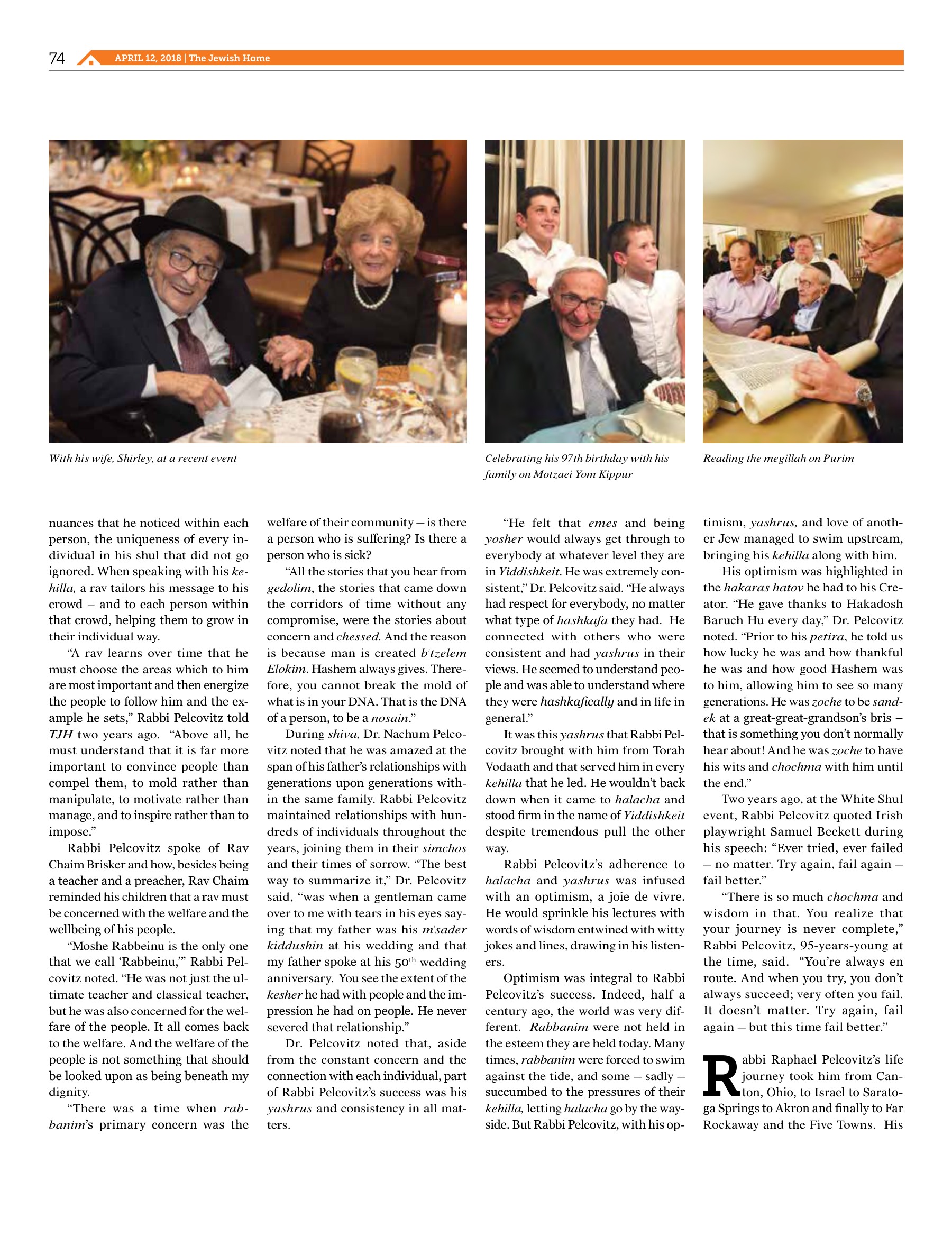
Speaking with TJH two years ago, Rabbi Raphael Pelcovitz, zt”l, noted at the end of the long interview that he knew thousands of people. “How do you manage to remember everyone?” the interviewer asked him. “Well, if I like you, I remember you,” the rav, who was 95 years old at the time, said. “You must like a lot of people,” the interviewer rejoined. “Yes, I definitely do,” Rabbi Pelcovitz responded.
An encounter with Rabbi Pelcovitz meant not just a few moments of chitchat. With his distinctive smile and wit, he instantly related to all, regardless of age, affiliation or attitude. People were not just congregants or passersby. They were humans, tzelem Elokim, each with their challenges and triumphs, accomplishments and losses, humor and pain.
Although Rabbi Pelcovitz was the consummate people’s person and that was his primary focus, his vision was broader in scope as he spent over six decades molding the Far Rockaway community into a bastion of Torah and derech eretz.
What was Rabbi Pelcovitz’s secret? How was he able to see a desert with just a few tents of Torah and then help to build the flourishing paradigm of Torah and tefilla that we have today in our community? How was he able to unite a kehilla that consists of black hats, baseball hats, and bare heads? How was he able to insist on halacha without alienating those who perhaps were not as stringent? Why did every person he encountered feel that instant connection with the rav?
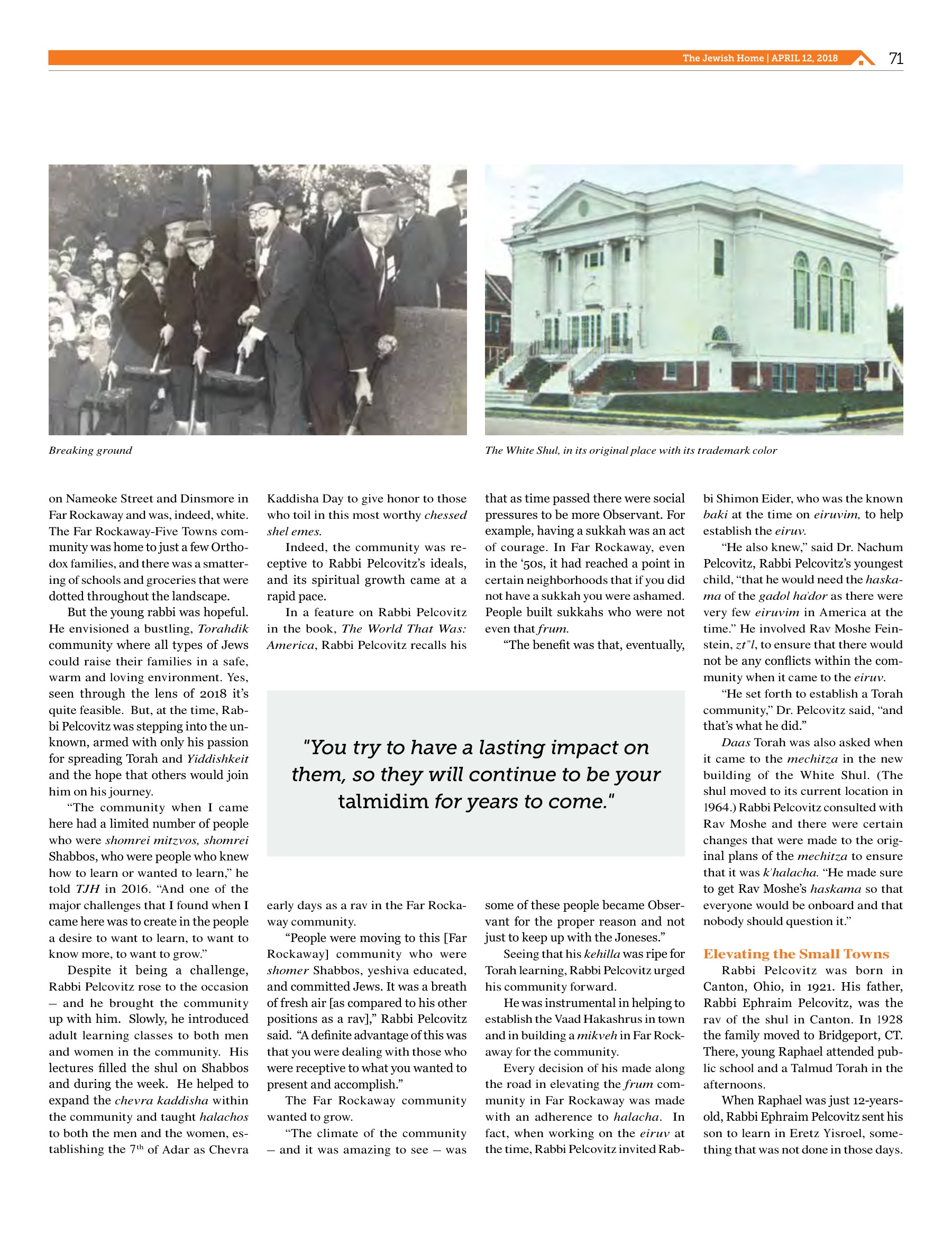
It was over six decades ago when Rabbi Raphael Pelcovitz, zt”l, moved to Far Rockaway. The then-fledgling community that sat on the border of Queens and the South Shore of the Five Towns was a new frontier for pioneering Orthodox Jews who were inching away from the tenements on the Lower East Side and the crowded streets of the Bronx. A large portion of what is now prime real estate in Far Rockaway was, back then, uninhabited marsh land. There were a total of two shuls in the area – Shaaray Tefila and Kneseth Israel, which was located on Nameoke Street and Dinsmore in Far Rockaway and was, indeed, white. The Far Rockaway-Five Towns community was home to just a few Orthodox families, and there was a smattering of schools and groceries that were dotted throughout the landscape.
But the young rabbi was hopeful. He envisioned a bustling, Torahdik community where all types of Jews could raise their families in a safe, warm and loving environment. Yes, seen through the lens of 2018 it’s quite feasible. But, at the time, Rabbi Pelcovitz was stepping into the unknown, armed with only his passion for spreading Torah and Yiddishkeit and the hope that others would join him on his journey.
“The community when I came here had a limited number of people who were shomrei mitzvos, shomrei Shabbos, who were people who knew how to learn or wanted to learn,” he told TJH in 2016. “And one of the major challenges that I found when I came here was to create in the people a desire to want to learn, to want to know more, to want to grow.”
Despite it being a challenge, Rabbi Pelcovitz rose to the occasion – and he brought the community up with him. Slowly, he introduced adult learning classes to both men and women in the community. His lectures filled the shul on Shabbos and during the week. He helped to expand the chevra kaddisha within the community and taught halachos to both the men and the women, establishing the 7th of Adar as Chevra Kaddisha Day to give honor to those who toil in this most worthy chessed shel emes.
Indeed, the community was receptive to Rabbi Pelcovitz’s ideals, and its spiritual growth came at a rapid pace.
In a feature on Rabbi Pelcovitz in the book, The World That Was: America, Rabbi Pelcovitz recalls his early days as a rav in the Far Rockaway community.
“People were moving to this [Far Rockaway] community who were shomer Shabbos, yeshiva educated, and committed Jews. It was a breath of fresh air [as compared to his other positions as a rav],” Rabbi Pelcovitz said. “A definite advantage of this was that you were dealing with those who were receptive to what you wanted to present and accomplish.”
The Far Rockaway community wanted to grow.
“The climate of the community – and it was amazing to see – was that as time passed there were social pressures to be more Observant. For example, having a sukkah was an act of courage. In Far Rockaway, even in the ‘50s, it had reached a point in certain neighborhoods that if you did not have a sukkah you were ashamed. People built sukkahs who were not even that frum.
“The benefit was that, eventually, some of these people became Observant for the proper reason and not just to keep up with the Joneses.”
Seeing that his kehilla was ripe for Torah learning, Rabbi Pelcovitz urged his community forward.
He was instrumental in helping to establish the Vaad Hakashrus in town and in building a mikveh in Far Rockaway for the community.
Every decision of his made along the road in elevating the frum community in Far Rockaway was made with an adherence to halacha. In fact, when working on the eiruv at the time, Rabbi Pelcovitz invited Rabbi Shimon Eider, who was the known baki at the time on eiruvim, to help establish the eiruv.
“He also knew,” said Dr. Nachum Pelcovitz, Rabbi Pelcovitz’s youngest child, “that he would need the haskama of the gadol ha’dor as there were very few eiruvim in America at the time.” He involved Rav Moshe Feinstein, zt”l, to ensure that there would not be any conflicts within the community when it came to the eiruv.
“He set forth to establish a Torah community,” Dr. Pelcovitz said, “and that’s what he did.”
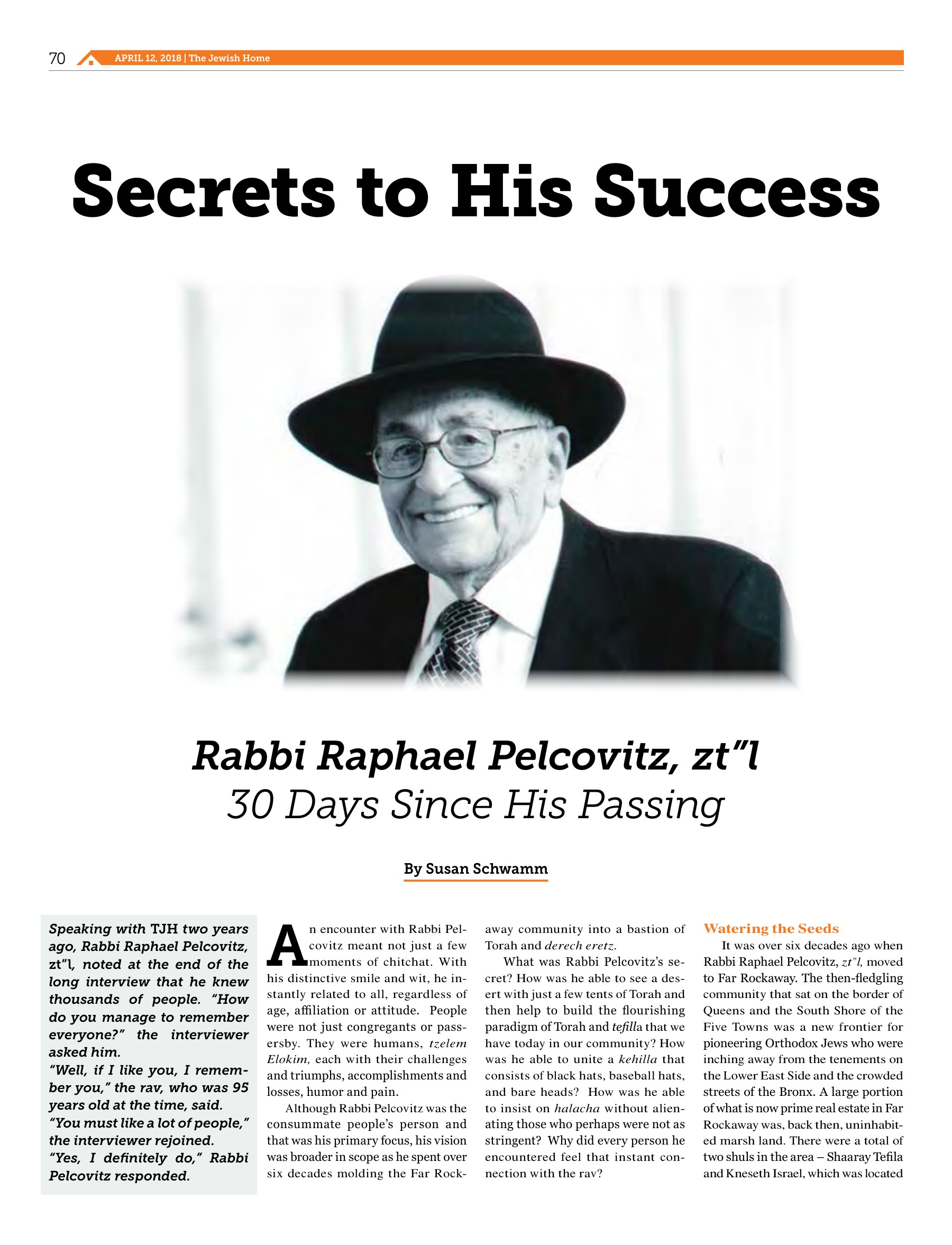
Daas Torah was also asked when it came to the mechitza in the new building of the White Shul. (The shul moved to its current location in 1964.) Rabbi Pelcovitz consulted with Rav Moshe and there were certain changes that were made to the original plans of the mechitza to ensure that it was k’halacha. “He made sure to get Rav Moshe’s haskama so that everyone would be onboard and that nobody should question it.”
Elevating the Small Towns
Rabbi Pelcovitz was born in Canton, Ohio, in 1921. His father, Rabbi Ephraim Pelcovitz, was the rav of the shul in Canton. In 1928 the family moved to Bridgeport, CT. There, young Raphael attended public school and a Talmud Torah in the afternoons.
When Raphael was just 12-years-old, Rabbi Ephraim Pelcovitz sent his son to learn in Eretz Yisroel, something that was not done in those days. Raphael traveled with his mother and sisters by boat for two weeks before finally reaching the Holy Land. His mother had traveled with his sisters to find a shidduch for one of the Pelcovitz daughters and, indeed, once they came to Eretz Yisroel, a suitable shidduch was found. The wedding was held in Eretz Yisroel after Rabbi Ephraim Pelcovitz journeyed from the United States to attend the simcha.
Rabbi Ephraim Pelcovitz, with his long white beard, was part of a group of rabbanim who joined in the Zionist conferences in Europe. Perhaps that it why he sent his son to learn in Eretz Yisroel at such a tender age.
After the nuptials, Raphael stayed in Israel with his sister and new brother-in-law and learned in the mechina of Chevron Yeshiva, celebrating his bar mitzvah without the rest of his family. He stayed there, learning diligently, for four years until unrest and riots forced him back home.
When Rabbi Pelcovitz came back from Eretz Yisroel, he went to Torah Vodaath, where he learned under Rabbi Shlomo Heiman. Rabbi Pelcovitz was known for being an ilui, earning a certificate of semicha from Rabbi Heiman at the young age of 20. When he was given the approbation Rabbi Heiman told him to hide the certificate in a drawer until he would come of age, as he was really much too young to have used it.
Learning in Torah Vodaath opened worlds for Rabbi Pelcovitz. He spoke of his love for his rebbe who taught him how to learn a blatt Gemara and how to give over a blatt, an essential component for rabbanim when learning with their kehilla.
Another person who had a seminal influence over Rabbi Pelcovitz while he was learning in Torah Vodaath was the menahel, Rabbi Shraga Feivel Mendelowitz. Rabbi Mendelowitz imparted hashkafa to the boys, giving over shiur to select bochurim.
In those days, there was no dormitory in the yeshiva; students would rent rooms. Rabbi Ephraim Pelcovitz would send his son money for room and board, and Raphael taught in the Talmud Torah to earn extra money.
Rabbi Raphael Pelcovitz’s first foray into chinuch was as the principal of a day school in Hartford, CT. In the 1940s, a day school was almost unheard of and the concept of not attending a public school was considered by many to be un-American. Despite the uphill battles and the very few supporters that he had, in his two years as principal Rabbi Pelcovitz expanded the school and recruited new students.
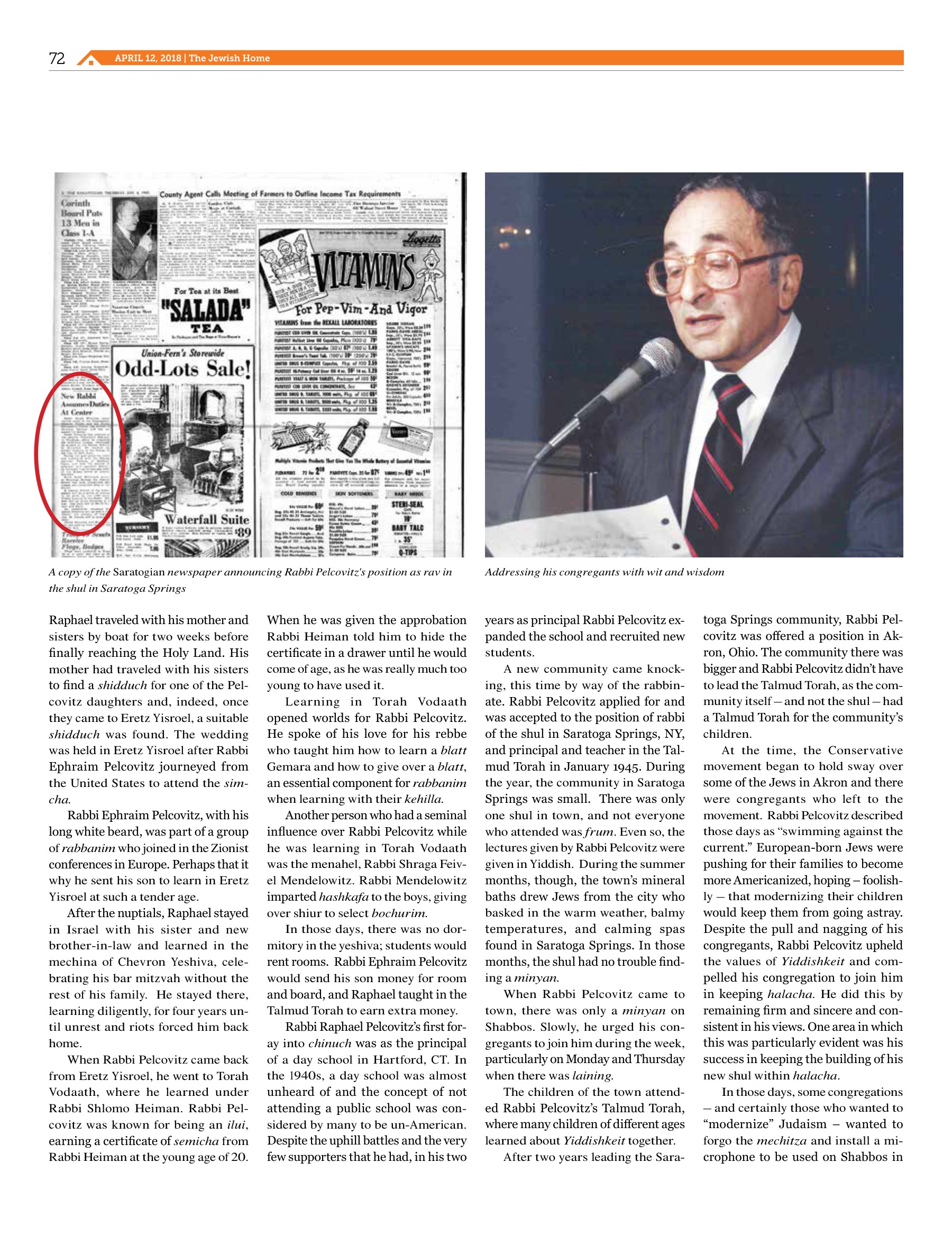
A new community came knocking, this time by way of the rabbinate. Rabbi Pelcovitz applied for and was accepted to the position of rabbi of the shul in Saratoga Springs, NY, and principal and teacher in the Talmud Torah in January 1945. During the year, the community in Saratoga Springs was small. There was only one shul in town, and not everyone who attended was frum. Even so, the lectures given by Rabbi Pelcovitz were given in Yiddish. During the summer months, though, the town’s mineral baths drew Jews from the city who basked in the warm weather, balmy temperatures, and calming spas found in Saratoga Springs. In those months, the shul had no trouble finding a minyan.
When Rabbi Pelcovitz came to town, there was only a minyan on Shabbos. Slowly, he urged his congregants to join him during the week, particularly on Monday and Thursday when there was laining.
The children of the town attended Rabbi Pelcovitz’s Talmud Torah, where many children of different ages learned about Yiddishkeit together.
After two years leading the Saratoga Springs community, Rabbi Pelcovitz was offered a position in Akron, Ohio. The community there was bigger and Rabbi Pelcovitz didn’t have to lead the Talmud Torah, as the community itself – and not the shul – had a Talmud Torah for the community’s children.
At the time, the Conservative movement began to hold sway over some of the Jews in Akron and there were congregants who left to the movement. Rabbi Pelcovitz described those days as “swimming against the current.” European-born Jews were pushing for their families to become more Americanized, hoping – foolishly – that modernizing their children would keep them from going astray. Despite the pull and nagging of his congregants, Rabbi Pelcovitz upheld the values of Yiddishkeit and compelled his congregation to join him in keeping halacha. He did this by remaining firm and sincere and consistent in his views. One area in which this was particularly evident was his success in keeping the building of his new shul within halacha.
In those days, some congregations – and certainly those who wanted to “modernize” Judaism – wanted to forgo the mechitza and install a microphone to be used on Shabbos in shul. But Rabbi Pelcovitz won on both counts when the new shul was built in Akron: it had a proper mechitza and there was no microphone.
“If you are strong and willing to do what is necessary, putting yourself on the line, 99% of people will accept what you say,” Rabbi Pelcovitz said about his time in Akron.
Rabbi Pelcovitz also observed that there was a lack of interest in his congregants in Yiddishkeit. The older generation was dying out; the younger generation didn’t have knowledge about their past. As such, he arranged classes to educate his members, calling am ha’aratzus the greatest threat to Yiddishkeit. He also reached out to them, connecting with them and forming friendships.
“It was not a conscious type of thing like today’s kiruv work – there was no label associated with it then,” he said of his relationships with his congregants. “You try to have a lasting impact on them, so they will continue to be your talmidim for years to come.”
Aside from the relationships with his members, in those days, being a rabbi in a small town bettered the community and made the congregants hold fast to their past. “Just the rabbi’s presence can have an effect,” Rabbi Pelcovitz noted. “I learned this from a man in Saratoga Springs. He came over to me and said, ‘I’m glad you’re in town because Pesach is coming and when a rabbi is in town I don’t eat chometz. When there is no rabbi I feel differently.’ Similarly, in Akron, people would say to me, ‘Your presence has an impact.’”
After a few years in Akron, Rabbi Pelcovitz made his way to Far Rockaway, NY. The rest, as they say, is history.
Secrets to Success
Just as a rav is multi-faceted, his kehilla is varied, with members spanning a spectrum in hashkafa, ideals and values. And each individual within that kehilla is unique, with distinctive character traits, wants and needs.
A good rav, then, in order to be successful, needs to be limber. He needs to be able to uplift his congregation regardless of where they stand. He needs to draw some closer than others; he needs to reach out further to others.
Rabbi Pelcovitz, in his three decades as rav of the White Shul, helped his kehilla reach new heights. It’s hard to pinpoint his secret to success. Perhaps that is because there was not just one secret behind his towering accomplishments.
Part of Rabbi Pelcovitz’s success in helping to cultivate a vibrant frum community in Far Rockaway was his focus on the youth. Families with children were moving into town and Rabbi Pelcovitz saw the utility of getting the youth involved. To that end, he helped establish a Youth Activities Committee, where young children were able to attend programs on Shabbos and Sunday. Ayouth minyan was formed; Shabbos afternoon groups were offered. Chol hamoed trips and activities for children on Sunday were instituted. The shul was not just a place to daven. It was a vibrant, integral part of the families’ lives.
The young families who were moving into town were welcomed into the shul, joining the board and helping to establish new programs. They felt that they were needed and instrumental in the shul’s success and growth.
Two years ago, when Rabbi Pelcovitz was feted at the White Shul for his 65 years of leadership in the community, he spoke of his sincere, deep love for his congregants and the community. “The secret of our success,” he told the crowd, “has been the fact that we’ve looked upon each other as achim, brothers. When we speak of achim, we are saying and we are looking at our connections – every man, every woman, every individual in shul – we were not just givers and receivers… We needed to be m’shtatef with one another.”
That relationship of giving to one another ensured a deep connection between the rav and his kehilla. “There is so much emes and so many feelings and emotions and so much ahava and kavod that are mutually flowing in two directions – of individual to his tzibbur and from the tzibbur to an individual,” Rabbi Pelcovitz said.
He urged the crowd, “You need to be extremely sensitive to every need of your students, your congregants, of your children, especially as they grow up.”
Perhaps that was also part of Rabbi Pelcovitz’s success. It was the nuances that he noticed within each person, the uniqueness of every individual in his shul that did not go ignored. When speaking with his kehilla, a rav tailors his message to his crowd – and to each person within that crowd, helping them to grow in their individual way.
“A rav learns over time that he must choose the areas which to him are most important and then energize the people to follow him and the example he sets,” Rabbi Pelcovitz told TJH two years ago. “Above all, he must understand that it is far more important to convince people than compel them, to mold rather than manipulate, to motivate rather than manage, and to inspire rather than to impose.”
Rabbi Pelcovitz spoke of Rav Chaim Brisker and how, besides being a teacher and a preacher, Rav Chaim reminded his children that a rav must be concerned with the welfare and the wellbeing of his people.
“Moshe Rabbeinu is the only one that we call ‘Rabbeinu,’” Rabbi Pelcovitz noted. “He was not just the ultimate teacher and classical teacher, but he was also concerned for the welfare of the people. It all comes back to the welfare. And the welfare of the people is not something that should be looked upon as being beneath my dignity.
“There was a time when rabbanim’s primary concern was the welfare of their community – is there a person who is suffering? Is there a person who is sick?
“All the stories that you hear from gedolim, the stories that came down the corridors of time without any compromise, were the stories about concern and chessed. And the reason is because man is created b’tzelem Elokim. Hashem always gives. Therefore, you cannot break the mold of what is in your DNA. That is the DNAof a person, to be a nosain.”
During shiva, Dr. Nachum Pelcovitz noted that he was amazed at the span of his father’s relationships with generations upon generations within the same family. Rabbi Pelcovitz maintained relationships with hundreds of individuals throughout the years, joining them in their simchos and their times of sorrow. “The best way to summarize it,” Dr. Pelcovitz said, “was when a gentleman came over to me with tears in his eyes saying that my father was his m’sader kiddushin at his wedding and that my father spoke at his 50th wedding anniversary. You see the extent of the kesher he had with people and the impression he had on people. He never severed that relationship.”
Dr. Pelcovitz noted that, aside from the constant concern and the connection with each individual, part of Rabbi Pelcovitz’s success was his yashrus and consistency in all matters.
“He felt that emes and being yosher would always get through to everybody at whatever level they are in Yiddishkeit. He was extremely consistent,” Dr. Pelcovitz said. “He always had respect for everybody, no matter what type of hashkafa they had. He connected with others who were consistent and had yashrus in their views. He seemed to understand people and was able to understand where they were hashkafically and in life in general.”
It was this yashrus that Rabbi Pelcovitz brought with him from Torah Vodaath and that served him in every kehilla that he led. He wouldn’t back down when it came to halacha and stood firm in the name of Yiddishkeit despite tremendous pull the other way.
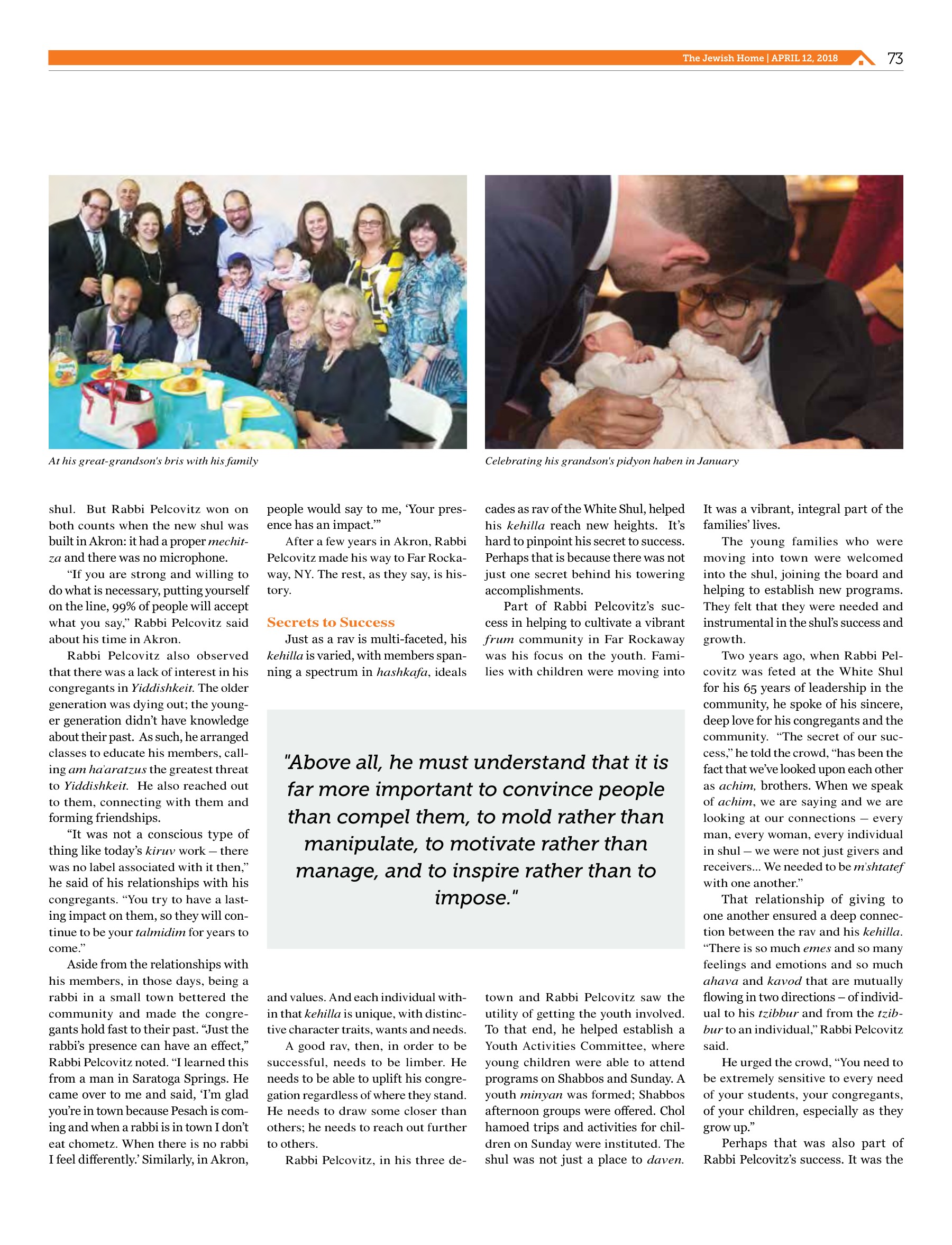
Rabbi Pelcovitz’s adherence to halacha and yashrus was infused with an optimism, a joie de vivre. He would sprinkle his lectures with words of wisdom entwined with witty jokes and lines, drawing in his listeners.
Optimism was integral to Rabbi Pelcovitz’s success. Indeed, half a century ago, the world was very different. Rabbanim were not held in the esteem they are held today. Many times, rabbanim were forced to swim against the tide, and some – sadly – succumbed to the pressures of their kehilla, letting halacha go by the wayside. But Rabbi Pelcovitz, with his optimism, yashrus, and love of another Jew managed to swim upstream, bringing his kehilla along with him.
His optimism was highlighted in the hakaras hatov he had to his Creator. “He gave thanks to Hakadosh Baruch Hu every day,” Dr. Pelcovitz noted. “Prior to his petira, he told us how lucky he was and how thankful he was and how good Hashem was to him, allowing him to see so many generations. He was zoche to be sandek at a great-great-grandson’s bris – that is something you don’t normally hear about! And he was zoche to have his wits and chochma with him until the end.”
Two years ago, at the White Shul event, Rabbi Pelcovitz quoted Irish playwright Samuel Beckett during his speech: “Ever tried, ever failed – no matter. Try again, fail again – fail better.”
“There is so much chochma and wisdom in that. You realize that your journey is never complete,” Rabbi Pelcovitz, 95-years-young at the time, said. “You’re always en route. And when you try, you don’t always succeed; very often you fail. It doesn’t matter. Try again, fail again – but this time fail better.”
Rabbi Raphael Pelcovitz’s life journey took him from Canton, Ohio, to Israel to Saratoga Springs to Akron and finally to Far Rockaway and the Five Towns. His voyage was filled with successes and challenges, and yet, throughout the decades, Rabbi Pelcovitz shouldered on. What may have been a journey started off by an intrepid American boy hoping to make a small mark on Judaism in America ended with him being forever remembered as a founding father of what is considered today to be one of the premier Orthodox communities around the globe.
His mission – accomplished. May HaRav Raphael ben HaRav Ephraim be a meilitz yosher for our community.
PUBLICATION NOTE
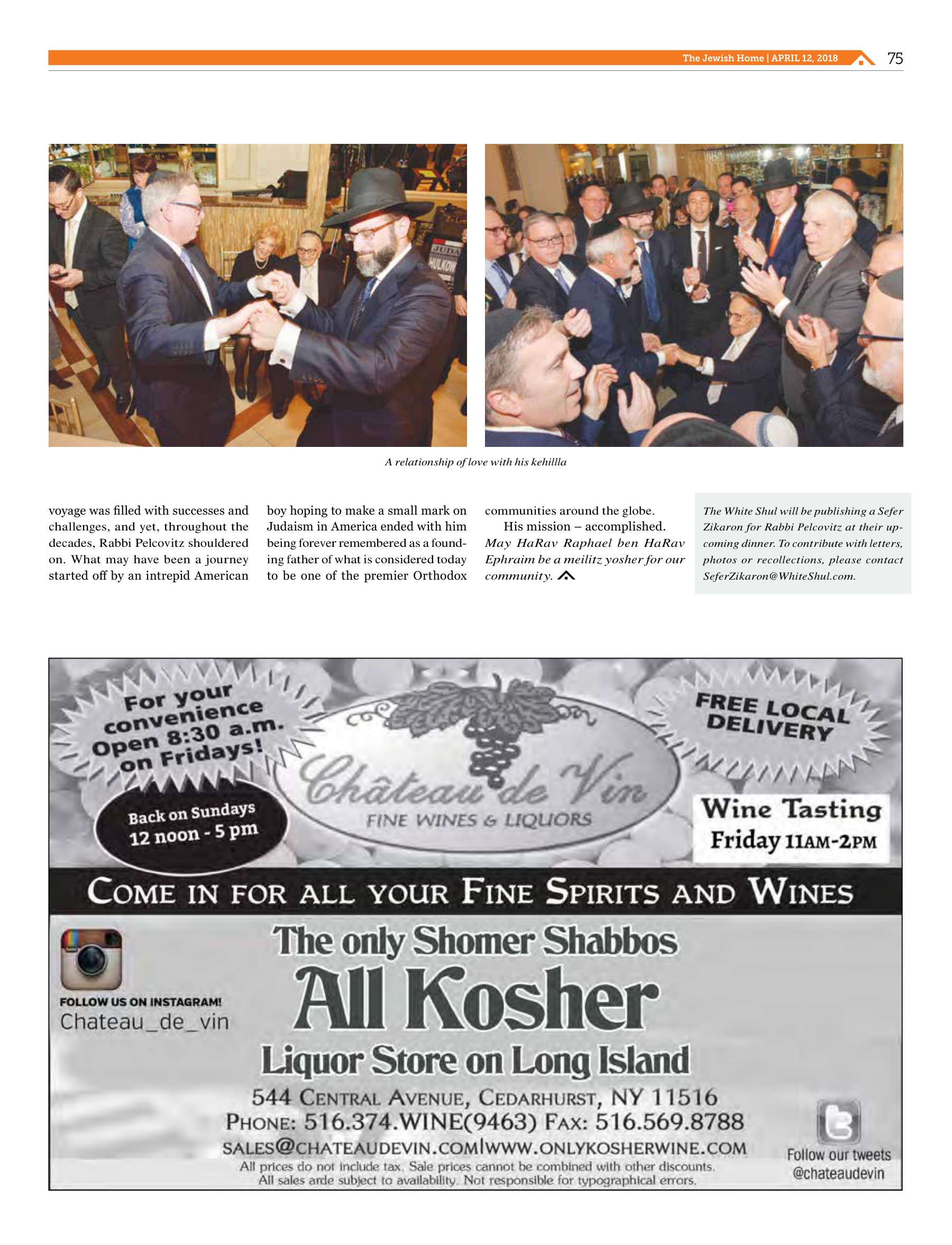
The White Shul will be publishing a Sefer Zikaron for Rabbi Pelcovitz at their upcoming dinner. To contribute with letters, photos or recollections, please contact SeferZikaron@WhiteShul.com.
Original newspaper pages and photographs
The Jewish Home · April 12, 2018 · page 70The Jewish Home · April 12, 2018 · page 71The Jewish Home · April 12, 2018 · page 72The Jewish Home · April 12, 2018 · page 73The Jewish Home · April 12, 2018 · page 74The Jewish Home · April 12, 2018 · page 75
From the archives · Rabbi Raphael Pelcovitz, zt”l (1921–2018)
This historical tribute is filed in WJJ’s memorial archive after Rabbi Pelcovitz’s passing on March 14, 2018. This digital archive edition was added on November 1, 2026. The original article was published by The Jewish Home on December 8, 2016. Original reporting and byline are retained below.
Rabbi Raphael “Ralph” Pelcovitz helped shape the White Shul and the Torah life of Far Rockaway and the Five Towns. This article forms part of Washington Jewish Journal’s archive of Jewish leadership, learning, and community history. Read the illustrated article in the Rabbi Pelcovitz Living Library and the original Jewish Home issue.
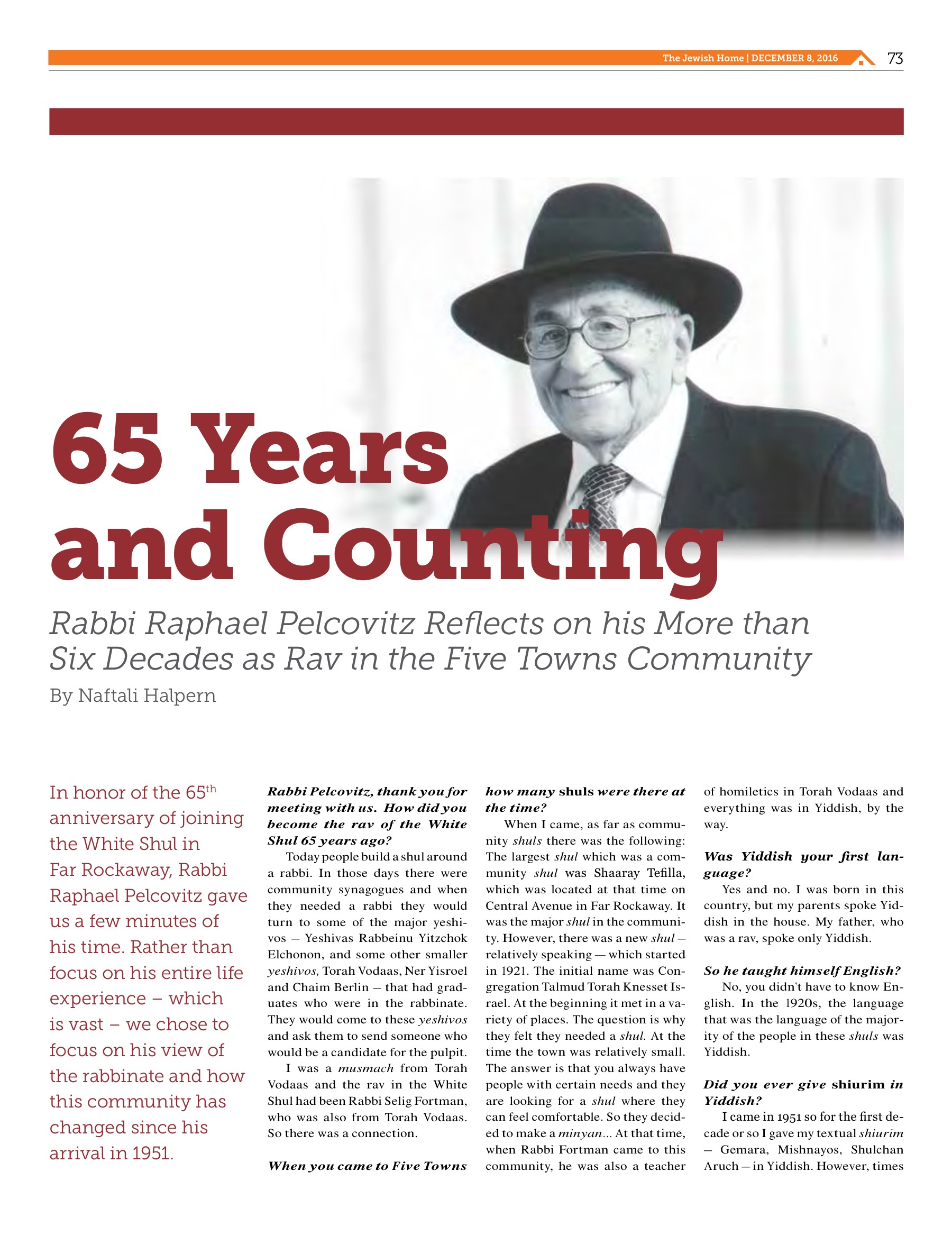
65 Years and Counting
Rabbi Raphael Pelcovitz Reflects on his More than Six Decades as Rav in the Five Towns Community
By Naftali Halpern · The Jewish Home · December 8, 2016
In honor of the 65th anniversary of joining the White Shul in Far Rockaway, Rabbi Raphael Pelcovitz gave us a few minutes of his time. Rather than focus on his entire life experience – which is vast – we chose to focus on his view of the rabbinate and how this community has changed since his arrival in 1951.
Rabbi Pelcovitz, thank you for meeting with us. How did you become the rav of the White Shul 65 years ago?
Today people build a shul around a rabbi. In those days there were community synagogues and when they needed a rabbi they would turn to some of the major yeshivos – Yeshivas Rabbeinu Yitzchok Elchonon, and some other smaller yeshivos, Torah Vodaas, Ner Yisroel and Chaim Berlin – that had graduates who were in the rabbinate. They would come to these yeshivos and ask them to send someone who would be a candidate for the pulpit.
I was a musmach from Torah Vodaas and the rav in the White Shul had been Rabbi Selig Fortman, who was also from Torah Vodaas. So there was a connection.
When you came to Five Towns how many shuls were there at the time?
When I came, as far as community shuls there was the following: The largest shul which was a community shul was Shaaray Tefilla, which was located at that time on Central Avenue in Far Rockaway. It was the major shul in the community. However, there was a new shul – relatively speaking — which started in 1921. The initial name was Congregation Talmud Torah Knesset Israel. At the beginning it met in a variety of places. The question is why they felt they needed a shul. At the time the town was relatively small. The answer is that you always have people with certain needs and they are looking for a shul where they can feel comfortable. So they decided to make a minyan… At that time, when Rabbi Fortman came to this community, he was also a teacher of homiletics in Torah Vodaas and everything was in Yiddish, by the way.
Was Yiddish your first language?
Yes and no. I was born in this country, but my parents spoke Yiddish in the house. My father, who was a rav, spoke only Yiddish.
So he taught himself English?
No, you didn’t have to know English. In the 1920s, the language that was the language of the majority of the people in these shuls was Yiddish.
Did you ever give shiurim in Yiddish?
I came in 1951 so for the first decade or so I gave my textual shiurim – Gemara, Mishnayos, Shulchan Aruch – in Yiddish. However, times were already changing and you had more and more people who were not conversant in Yiddish.
How has the rabbinate changed since you started at the White Shul?
One of the major changes is that when I started at the White Shul, it was a tekufa of rabbanus when it did not grow around the individual. The individual was no different than any professional. The community had a shul and it needed spiritual leadership. So the people went looking and searching for a person who would be fitting for that position.
Today it is almost the opposite. It’s almost always the case where a person comes to the community and he has people cluster around him and he becomes the focal point and then they say, “Let’s make a shul and make you our rabbi.”
Is there a danger to that?
Of course there is because very often a person who is not fit and doesn’t have the talent and doesn’t have the organization ability and doesn’t even have the basic skills becomes a rabbi of the community and he is not fit to serve in that position. When it works the other way around, he already has chosen to hone any skills he may have. He has worked a smaller position in a smaller town and developed skills and when he comes to a big shul he is the consummate professional.
What is the key character trait that you think is necessary in order for one to be an effective rabbi?
Rabbi Akiva Eiger was once asked by a young student who planned to enter the rabbinate, “How can I be a success?” Reb Akiva Eiger said to him, “People have been traveling on the high seas for thousands of years, but no one has made a highway yet.”
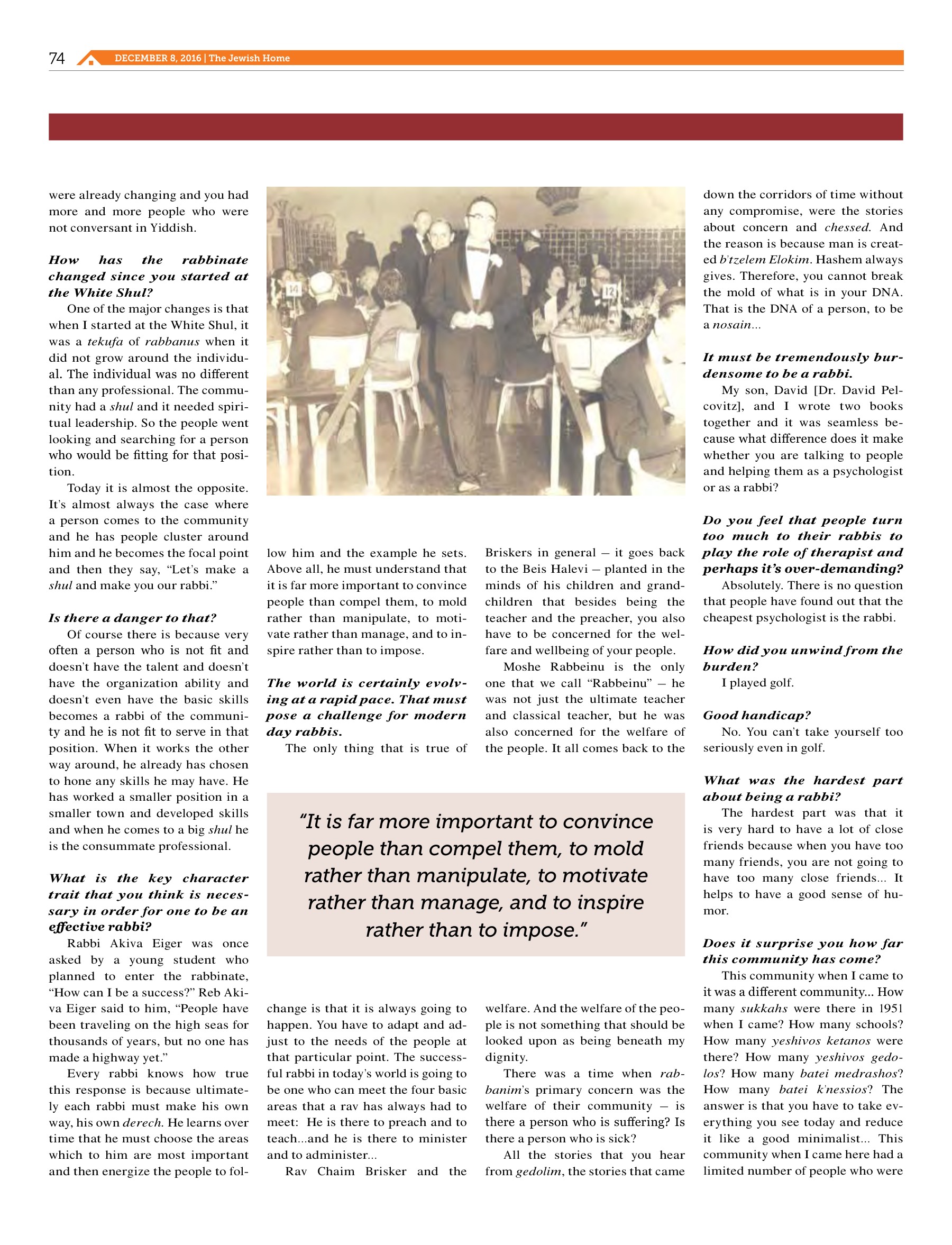
Every rabbi knows how true this response is because ultimately each rabbi must make his own way, his own derech. He learns over time that he must choose the areas which to him are most important and then energize the people to follow him and the example he sets. Above all, he must understand that it is far more important to convince people than compel them, to mold rather than manipulate, to motivate rather than manage, and to inspire rather than to impose.
The world is certainly evolving at a rapid pace. That must pose a challenge for modern day rabbis.
The only thing that is true of change is that it is always going to happen. You have to adapt and adjust to the needs of the people at that particular point. The successful rabbi in today’s world is going to be one who can meet the four basic areas that a rav has always had to meet: He is there to preach and to teach…and he is there to minister and to administer…
Rav Chaim Brisker and the Briskers in general – it goes back to the Beis Halevi – planted in the minds of his children and grandchildren that besides being the teacher and the preacher, you also have to be concerned for the welfare and wellbeing of your people.
Moshe Rabbeinu is the only one that we call “Rabbeinu” – he was not just the ultimate teacher and classical teacher, but he was also concerned for the welfare of the people. It all comes back to the welfare. And the welfare of the people is not something that should be looked upon as being beneath my dignity.
There was a time when rabbanim’s primary concern was the welfare of their community – is there a person who is suffering? Is there a person who is sick?
All the stories that you hear from gedolim, the stories that came down the corridors of time without any compromise, were the stories about concern and chessed. And the reason is because man is created b’tzelem Elokim. Hashem always gives. Therefore, you cannot break the mold of what is in your DNA. That is the DNA of a person, to be a nosain…
It must be tremendously burdensome to be a rabbi.
My son, David [Dr. David Pelcovitz], and I wrote two books together and it was seamless because what difference does it make whether you are talking to people and helping them as a psychologist or as a rabbi?
Do you feel that people turn too much to their rabbis to play the role of therapist and perhaps it’s over-demanding?
Absolutely. There is no question that people have found out that the cheapest psychologist is the rabbi.
How did you unwind from the burden?
I played golf.
Good handicap?
No. You can’t take yourself too seriously even in golf.
What was the hardest part about being a rabbi?
The hardest part was that it is very hard to have a lot of close friends because when you have too many friends, you are not going to have too many close friends… It helps to have a good sense of humor.
Does it surprise you how far this community has come?
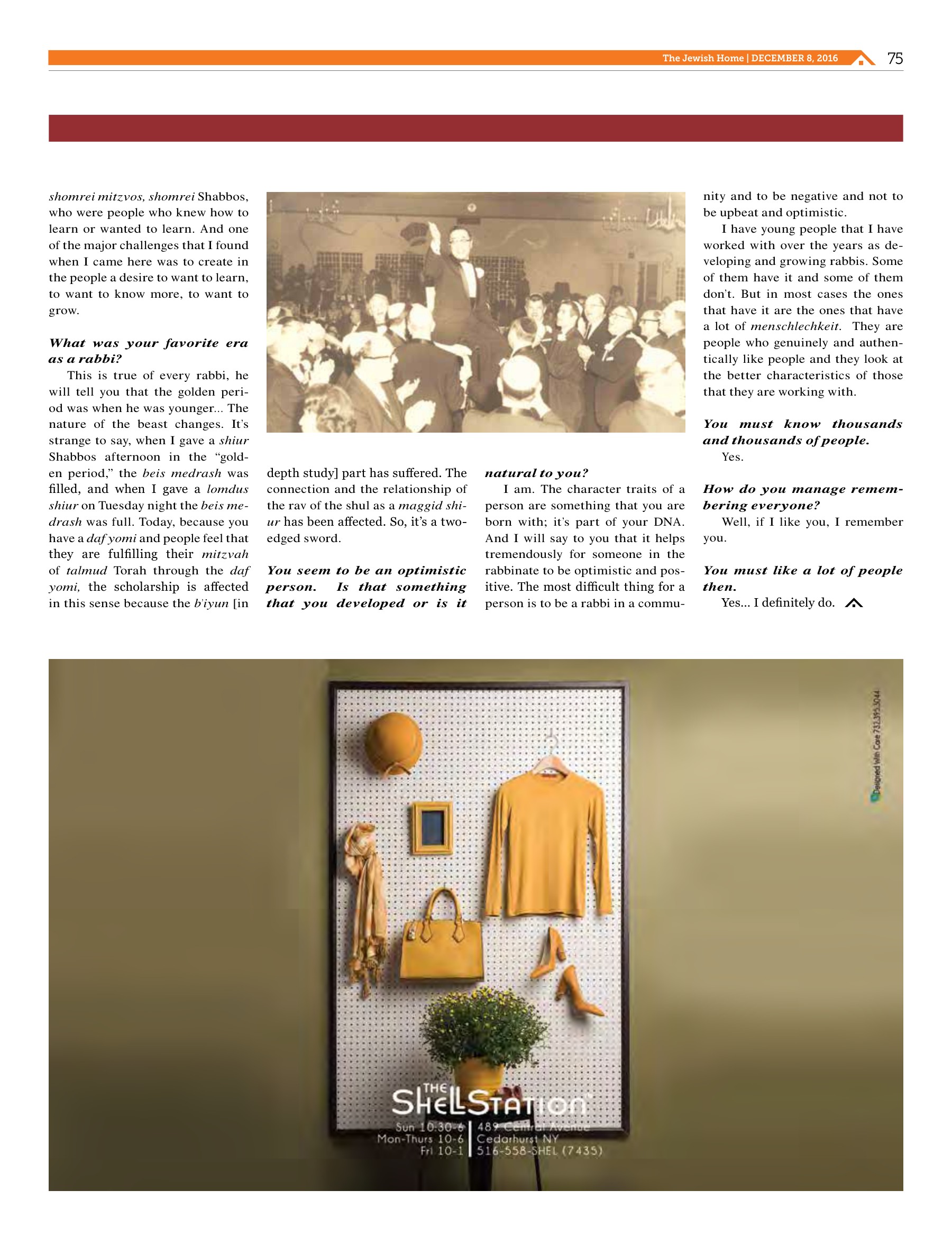
This community when I came to it was a different community… How many sukkahs were there in 1951 when I came? How many schools? How many yeshivos ketanos were there? How many yeshivos gedolos? How many batei medrashos? How many batei k’nessios? The answer is that you have to take everything you see today and reduce it like a good minimalist… This community when I came here had a limited number of people who were shomrei mitzvos, shomrei Shabbos, who were people who knew how to learn or wanted to learn. And one of the major challenges that I found when I came here was to create in the people a desire to want to learn, to want to know more, to want to grow.
What was your favorite era as a rabbi?
This is true of every rabbi, he will tell you that the golden period was when he was younger… The nature of the beast changes. It’s strange to say, when I gave a shiur Shabbos afternoon in the “golden period,” the beis medrash was filled, and when I gave a lomdus shiur on Tuesday night the beis medrash was full. Today, because you have a daf yomi and people feel that they are fulfilling their mitzvah of talmud Torah through the daf yomi, the scholarship is affected in this sense because the b’iyun [in depth study] part has suffered. The connection and the relationship of the rav of the shul as a maggid shiur has been affected. So, it’s a two-edged sword.
You seem to be an optimistic person. Is that something that you developed or is it natural to you?
I am. The character traits of a person are something that you are born with; it’s part of your DNA. And I will say to you that it helps tremendously for someone in the rabbinate to be optimistic and positive. The most difficult thing for a person is to be a rabbi in a community and to be negative and not to be upbeat and optimistic.
I have young people that I have worked with over the years as developing and growing rabbis. Some of them have it and some of them don’t. But in most cases the ones that have it are the ones that have a lot of menschlechkeit. They are people who genuinely and authentically like people and they look at the better characteristics of those that they are working with.
You must know thousands and thousands of people.
Yes.
How do you manage remembering everyone?
Well, if I like you, I remember you.
You must like a lot of people then.
Yes… I definitely do.
Original newspaper pages and photographs
The Jewish Home · December 8, 2016 · page 73The Jewish Home · December 8, 2016 · page 74The Jewish Home · December 8, 2016 · page 75