From the archives · Rabbi Raphael Pelcovitz, zt”l (1921–2018)
This historical tribute is filed in WJJ’s memorial archive after Rabbi Pelcovitz’s passing on March 14, 2018. This digital archive edition was added on November 1, 2026. The original article was published by The Jewish Home on December 8, 2016. Original reporting and byline are retained below.
Rabbi Raphael “Ralph” Pelcovitz helped shape the White Shul and the Torah life of Far Rockaway and the Five Towns. This article forms part of Washington Jewish Journal’s archive of Jewish leadership, learning, and community history. Read the illustrated article in the Rabbi Pelcovitz Living Library and the original Jewish Home issue.
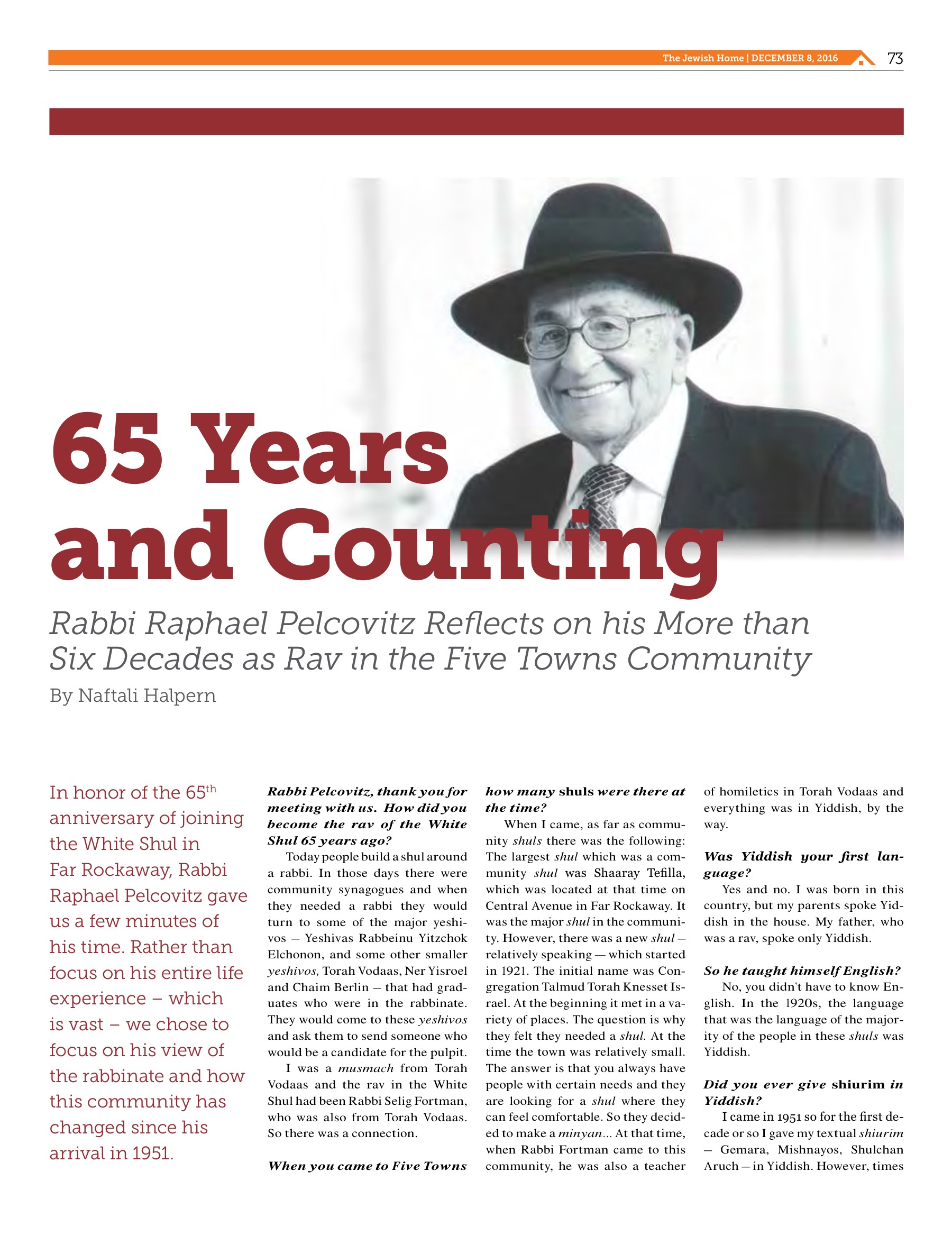
65 Years and Counting
Rabbi Raphael Pelcovitz Reflects on his More than Six Decades as Rav in the Five Towns Community
By Naftali Halpern · The Jewish Home · December 8, 2016
In honor of the 65th anniversary of joining the White Shul in Far Rockaway, Rabbi Raphael Pelcovitz gave us a few minutes of his time. Rather than focus on his entire life experience – which is vast – we chose to focus on his view of the rabbinate and how this community has changed since his arrival in 1951.
Rabbi Pelcovitz, thank you for meeting with us. How did you become the rav of the White Shul 65 years ago?
Today people build a shul around a rabbi. In those days there were community synagogues and when they needed a rabbi they would turn to some of the major yeshivos – Yeshivas Rabbeinu Yitzchok Elchonon, and some other smaller yeshivos, Torah Vodaas, Ner Yisroel and Chaim Berlin – that had graduates who were in the rabbinate. They would come to these yeshivos and ask them to send someone who would be a candidate for the pulpit.
I was a musmach from Torah Vodaas and the rav in the White Shul had been Rabbi Selig Fortman, who was also from Torah Vodaas. So there was a connection.
When you came to Five Towns how many shuls were there at the time?
When I came, as far as community shuls there was the following: The largest shul which was a community shul was Shaaray Tefilla, which was located at that time on Central Avenue in Far Rockaway. It was the major shul in the community. However, there was a new shul – relatively speaking — which started in 1921. The initial name was Congregation Talmud Torah Knesset Israel. At the beginning it met in a variety of places. The question is why they felt they needed a shul. At the time the town was relatively small. The answer is that you always have people with certain needs and they are looking for a shul where they can feel comfortable. So they decided to make a minyan… At that time, when Rabbi Fortman came to this community, he was also a teacher of homiletics in Torah Vodaas and everything was in Yiddish, by the way.
Was Yiddish your first language?
Yes and no. I was born in this country, but my parents spoke Yiddish in the house. My father, who was a rav, spoke only Yiddish.
So he taught himself English?
No, you didn’t have to know English. In the 1920s, the language that was the language of the majority of the people in these shuls was Yiddish.
Did you ever give shiurim in Yiddish?
I came in 1951 so for the first decade or so I gave my textual shiurim – Gemara, Mishnayos, Shulchan Aruch – in Yiddish. However, times were already changing and you had more and more people who were not conversant in Yiddish.
How has the rabbinate changed since you started at the White Shul?
One of the major changes is that when I started at the White Shul, it was a tekufa of rabbanus when it did not grow around the individual. The individual was no different than any professional. The community had a shul and it needed spiritual leadership. So the people went looking and searching for a person who would be fitting for that position.
Today it is almost the opposite. It’s almost always the case where a person comes to the community and he has people cluster around him and he becomes the focal point and then they say, “Let’s make a shul and make you our rabbi.”
Is there a danger to that?
Of course there is because very often a person who is not fit and doesn’t have the talent and doesn’t have the organization ability and doesn’t even have the basic skills becomes a rabbi of the community and he is not fit to serve in that position. When it works the other way around, he already has chosen to hone any skills he may have. He has worked a smaller position in a smaller town and developed skills and when he comes to a big shul he is the consummate professional.
What is the key character trait that you think is necessary in order for one to be an effective rabbi?
Rabbi Akiva Eiger was once asked by a young student who planned to enter the rabbinate, “How can I be a success?” Reb Akiva Eiger said to him, “People have been traveling on the high seas for thousands of years, but no one has made a highway yet.”
Every rabbi knows how true this response is because ultimately each rabbi must make his own way, his own derech. He learns over time that he must choose the areas which to him are most important and then energize the people to follow him and the example he sets. Above all, he must understand that it is far more important to convince people than compel them, to mold rather than manipulate, to motivate rather than manage, and to inspire rather than to impose.
The world is certainly evolving at a rapid pace. That must pose a challenge for modern day rabbis.
The only thing that is true of change is that it is always going to happen. You have to adapt and adjust to the needs of the people at that particular point. The successful rabbi in today’s world is going to be one who can meet the four basic areas that a rav has always had to meet: He is there to preach and to teach…and he is there to minister and to administer…
Rav Chaim Brisker and the Briskers in general – it goes back to the Beis Halevi – planted in the minds of his children and grandchildren that besides being the teacher and the preacher, you also have to be concerned for the welfare and wellbeing of your people.
Moshe Rabbeinu is the only one that we call “Rabbeinu” – he was not just the ultimate teacher and classical teacher, but he was also concerned for the welfare of the people. It all comes back to the welfare. And the welfare of the people is not something that should be looked upon as being beneath my dignity.
There was a time when rabbanim’s primary concern was the welfare of their community – is there a person who is suffering? Is there a person who is sick?
All the stories that you hear from gedolim, the stories that came down the corridors of time without any compromise, were the stories about concern and chessed. And the reason is because man is created b’tzelem Elokim. Hashem always gives. Therefore, you cannot break the mold of what is in your DNA. That is the DNA of a person, to be a nosain…
It must be tremendously burdensome to be a rabbi.
My son, David [Dr. David Pelcovitz], and I wrote two books together and it was seamless because what difference does it make whether you are talking to people and helping them as a psychologist or as a rabbi?
Do you feel that people turn too much to their rabbis to play the role of therapist and perhaps it’s over-demanding?
Absolutely. There is no question that people have found out that the cheapest psychologist is the rabbi.
How did you unwind from the burden?
I played golf.
Good handicap?
No. You can’t take yourself too seriously even in golf.
What was the hardest part about being a rabbi?
The hardest part was that it is very hard to have a lot of close friends because when you have too many friends, you are not going to have too many close friends… It helps to have a good sense of humor.
Does it surprise you how far this community has come?
This community when I came to it was a different community… How many sukkahs were there in 1951 when I came? How many schools? How many yeshivos ketanos were there? How many yeshivos gedolos? How many batei medrashos? How many batei k’nessios? The answer is that you have to take everything you see today and reduce it like a good minimalist… This community when I came here had a limited number of people who were shomrei mitzvos, shomrei Shabbos, who were people who knew how to learn or wanted to learn. And one of the major challenges that I found when I came here was to create in the people a desire to want to learn, to want to know more, to want to grow.
What was your favorite era as a rabbi?
This is true of every rabbi, he will tell you that the golden period was when he was younger… The nature of the beast changes. It’s strange to say, when I gave a shiur Shabbos afternoon in the “golden period,” the beis medrash was filled, and when I gave a lomdus shiur on Tuesday night the beis medrash was full. Today, because you have a daf yomi and people feel that they are fulfilling their mitzvah of talmud Torah through the daf yomi, the scholarship is affected in this sense because the b’iyun [in depth study] part has suffered. The connection and the relationship of the rav of the shul as a maggid shiur has been affected. So, it’s a two-edged sword.
You seem to be an optimistic person. Is that something that you developed or is it natural to you?
I am. The character traits of a person are something that you are born with; it’s part of your DNA. And I will say to you that it helps tremendously for someone in the rabbinate to be optimistic and positive. The most difficult thing for a person is to be a rabbi in a community and to be negative and not to be upbeat and optimistic.
I have young people that I have worked with over the years as developing and growing rabbis. Some of them have it and some of them don’t. But in most cases the ones that have it are the ones that have a lot of menschlechkeit. They are people who genuinely and authentically like people and they look at the better characteristics of those that they are working with.
You must know thousands and thousands of people.
Yes.
How do you manage remembering everyone?
Well, if I like you, I remember you.
You must like a lot of people then.
Yes… I definitely do.
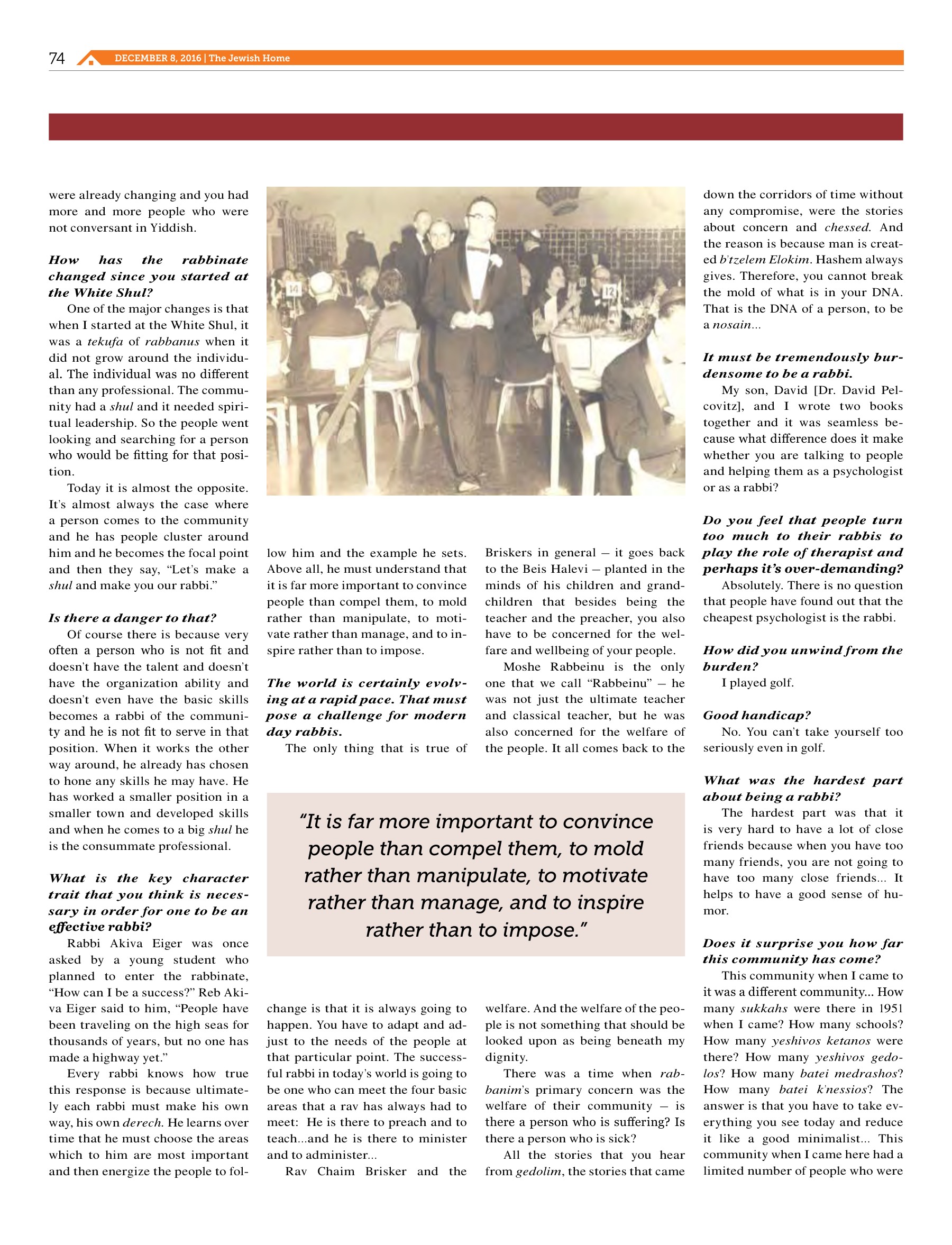
Original newspaper pages and photographs
Explore Rabbi Pelcovitz’s Torah and legacy
- Rabbi Raphael “Ralph” Pelcovitz: biography and community leadership
- Rabbi Pelcovitz’s audio recordings and shiurim
- Books, translations, and written Torah
- Sforno on Chumash — English translation and notes
- Balanced Parenting, with Dr. David Pelcovitz
- Documented research sources