
A WJJ Conversation
Built to Solve with Uri Levine
Uri Levine on Waze, the problems worth solving and what keeps an entrepreneur moving.
Interview byDovi Neuberger and Sender Gross
Traffic is familiar. Building a company that changes how millions of people navigate it requires a different kind of attention. Waze co-founder Uri Levine has built his career around noticing everyday frustrations and asking how they could be solved. In this WJJ conversation, comedian and media personality Dovi Neuberger joins his cousin, WJJ founder and publisher Sender Gross, to explore the thinking behind the app, the Google acquisition and the persistence that entrepreneurship demands.
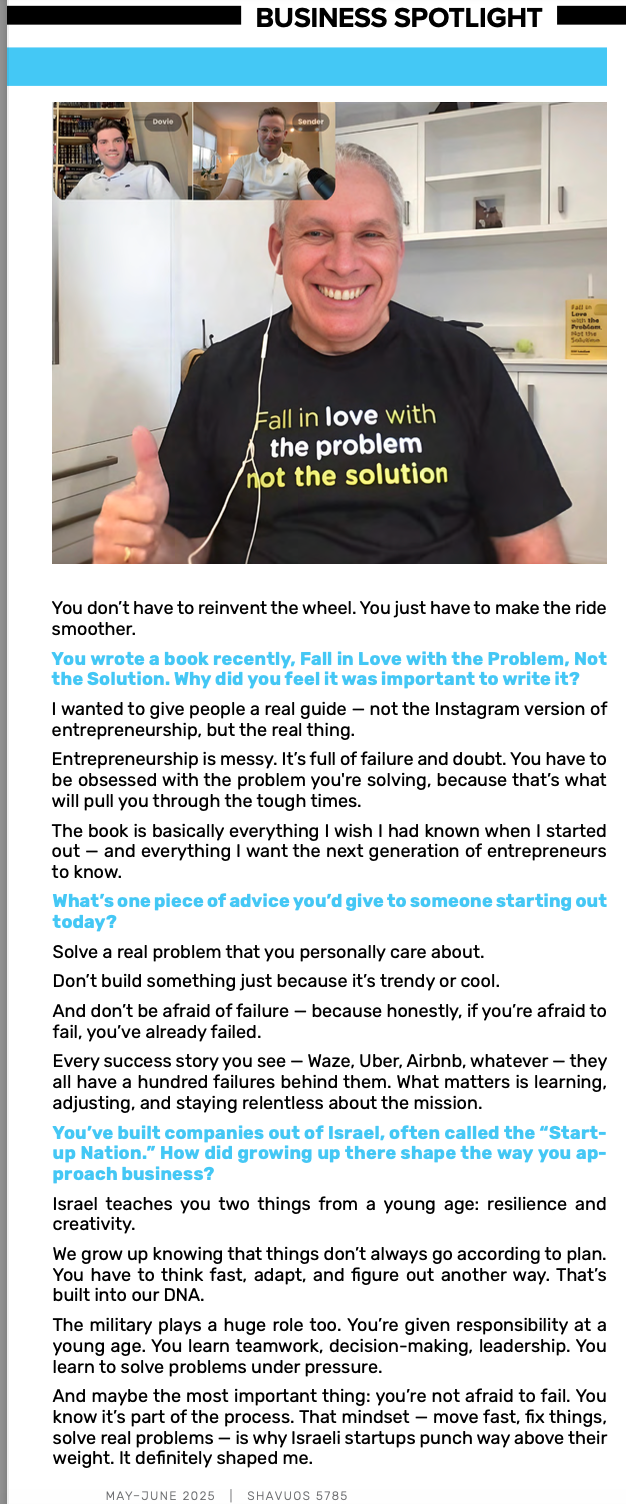
Adapted from WJJ’s May–June 2025 print interview. Questions have been edited for flow. The responses preserve the content of the published conversation.
A conversation about building something that matters
Uri Levine helped millions of drivers beat traffic by co-founding Waze, which Google acquired for more than a billion dollars. In this conversation, he discusses how Waze came to life, the role of failure and the curiosity that keeps him looking for the next problem to solve.
What was your first reaction when Google came to buy Waze?
It was crazy. Totally surreal. You build something from nothing, putting in years of sweat and doubt, and suddenly one of the biggest companies in the world wants it.
We were proud, for sure—but we were also very protective. We didn’t create Waze just to cash out. We created it to solve a huge pain point for drivers. Google really understood that, and that’s why it felt right. They respected what we had built, and more importantly, they respected the community behind it.
Was it emotional when you actually closed the deal?
It felt like handing over your child. We had built a company, but more than that, we had built a movement—drivers helping drivers, in real time, to make life just a little bit better.
Even after the deal, what mattered most to me was seeing that the community stayed strong. That meant everything.
Waze has so many features. What is your personal favorite?
The real-time traffic updates. No question.
Before Waze, navigation apps were basically static. You got directions, but they didn’t know what was happening five minutes ahead of you.
Waze changed all that. We turned every driver into a live sensor. Suddenly, your app could tell you there’s traffic, or an accident, or even a police car up ahead—not because a satellite said so, but because another driver just like you reported it. That real-time community feedback—it’s still the heart of Waze.
You’ve talked about falling in love with the problem. What do you mean?
A lot of entrepreneurs fall in love with their product. They think, “This thing I built is amazing.”
But if you focus only on your solution, you stop listening. You stop adapting.
You have to fall in love with the problem. If you deeply understand the problem you’re trying to solve, you’ll find a way. You’ll pivot when you need to, you’ll improve when you have to. But if you’re just obsessed with your own idea, you’ll get stuck.
It’s the biggest difference between startups that survive—and startups that don’t.
What was the problem you fell in love with at Waze?
Traffic.
I hated sitting in traffic. Everyone hates sitting in traffic. It’s one of those universal frustrations—wasting time, burning fuel, getting stressed out.
Once we really focused on that pain point—not maps, not navigation, but saving people time and frustration—everything clicked into place. That was the compass for every decision we made.
How do you choose which problems to work on next?
It usually starts with my own frustration.
If I find myself saying, “Why isn’t there a better way to do this?”—that’s a red flag for opportunity.
Then I ask two things: is this a big problem for a lot of people, and are the current solutions terrible? If both are true, that’s where you want to be.
That’s where real startup ideas come from—not brainstorming in a room, but living real life and getting annoyed enough to want to fix something.
Do you have to invent something totally new to succeed?
Not at all.
Uber didn’t invent taxis. Airbnb didn’t invent vacation rentals. Waze didn’t invent maps.
What we all did was take something broken—something frustrating—and make it better.
You don’t have to reinvent the wheel. You just have to make the ride smoother.
Why did you feel it was important to write your book?
I wanted to give people a real guide—not the Instagram version of entrepreneurship, but the real thing.
Entrepreneurship is messy. It’s full of failure and doubt. You have to be obsessed with the problem you’re solving, because that’s what will pull you through the tough times.
The book is basically everything I wish I had known when I started out—and everything I want the next generation of entrepreneurs to know.
What advice would you give someone starting out today?
Solve a real problem that you personally care about.
Don’t build something just because it’s trendy or cool.
And don’t be afraid of failure—because honestly, if you’re afraid to fail, you’ve already failed.
Every success story you see—Waze, Uber, Airbnb, whatever—they all have a hundred failures behind them. What matters is learning, adjusting, and staying relentless about the mission.
How did growing up in Israel shape your approach to business?
Israel teaches you two things from a young age: resilience and creativity.
We grow up knowing that things don’t always go according to plan. You have to think fast, adapt, and figure out another way. That’s built into our DNA.
The military plays a huge role too. You’re given responsibility at a young age. You learn teamwork, decision-making, leadership. You learn to solve problems under pressure.
And maybe the most important thing: you’re not afraid to fail. You know it’s part of the process. That mindset—move fast, fix things, solve real problems—is why Israeli startups punch way above their weight. It definitely shaped me.
What still drives you forward every day?
Curiosity, without a doubt.
I still wake up asking, “What’s broken? What can be better?”
There are so many problems out there waiting to be solved. And every time you find one—every time you help make life a little easier, a little faster, a little better for people—it’s the most rewarding feeling there is.
That’s what keeps me going. It’s not about the exit. It’s not about the title. It’s about solving the next problem.
What would you like to leave readers with?
If there’s one thing I hope you take away, it’s this:
Don’t wait until you have the perfect idea. Don’t wait for perfect timing. Start now.
Find a real problem that frustrates you, and fall in love with solving it.
If you stay focused on that—not on being fancy, not on getting approval—but on truly helping people, you’ll be amazed at what you can build.
The world doesn’t need more ideas. It needs more people who care enough to fix things.
About the author
Dovi Neuberger
Comedian, media personality and WJJ interviewer
Dovi Neuberger is a comedian, media personality and Washington Jewish Journal interviewer. His WJJ conversations bring readers into discussions with public figures, entrepreneurs and voices from across the Jewish community.
About the guest
Uri Levine
Uri Levine is an Israeli entrepreneur, Waze co-founder and author. Google acquired Waze in 2013. He was an early investor and first board member at Moovit, which Intel acquired in 2020. His writing, teaching and public speaking draw on the process of building companies, understanding customer problems and learning from setbacks.
About the contributors
Dovi Neuberger
Dovi Neuberger is a comedian, content creator, and interviewer whose work draws on Jewish life and the experiences of the Orthodox community. A host of Washington Jewish Journal conversations alongside publisher Sender Gross, he has interviewed guests including Lizzy and Dr. Ira Savetsky, parenting author Sharon Mazel, and former Maryland Governor Larry Hogan. The magazine’s print byline also appears as Dovie Neuberger.
More by and about Dovi NeubergerUri Levine
Uri Levine is an Israeli entrepreneur, Waze co-founder and author. Google acquired Waze in 2013. Levine was also an early investor and first board member at Moovit, which Intel acquired in 2020. His writing and public speaking focus on building companies around meaningful customer problems and learning through the startup journey.
More by and about Uri Levine